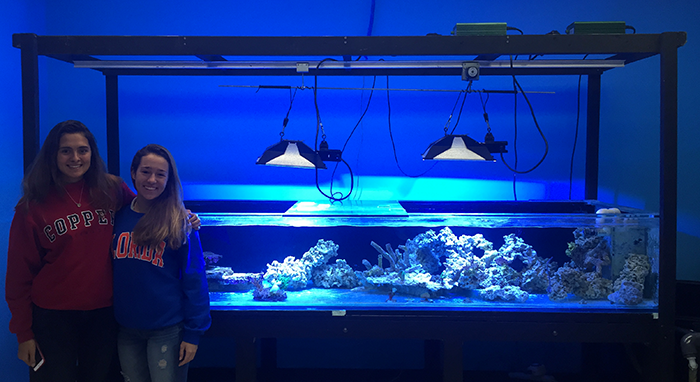
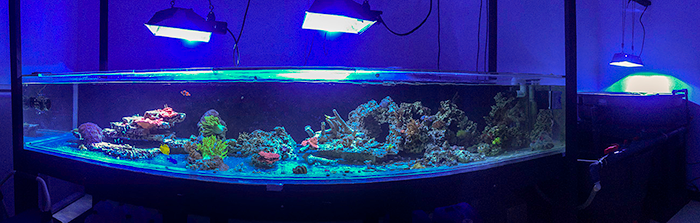
Members of the Gables Earth Club with the 300 gallon Coral Morphologic reef aquarium post-installation in 2015.
In September 2015 the lease ended on our first lab warehouse and we had to downsize our systems. We decided to donate our 300 gallon glass reef aquarium system–complete with all the gear, rocks, and corals–to the students of Coral Gables Senior High School in order to plant the seeds of reefkeeping and coral aquaculture in the next generation. The lab is maintained by student members of the Gables Earth Club, and overseen by faculty science teacher Mr. Eric Molina. We believe that no other activity accomplishes the goals of STEAM (Science, Technology, Engineering, Art, Math) better than reef keeping, and includes an added R for Responsibility (STREAM). While math and science can be taught from textbooks, the holistic act of coral aquaculture requires hands-on attention and care. We’ve observed firsthand how these students understood the assignment and really have gone above and beyond to care for these delicate creatures.
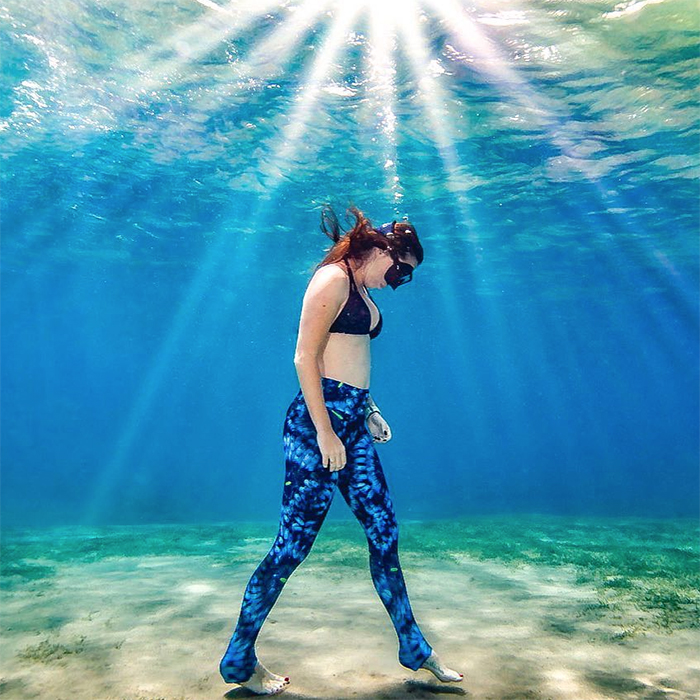
We are pleased to share the release of a series of apparel recycled from post-consumer plastic bottles, in collaboration with our friends at Waterlust. The ‘Cosmic Coral’ line features Coral Morphologic zoanthid, man o war, and flower anemone prints, and are now available to purchase from the Waterlust online shop. The leggings are 86% RPET (recycled polyester), 14% lycra, giving 10 post-consumer plastic bottles a positive future. Additionally, they are printed using dye-sublimation, an environmentally friendly process which uses no water and minimizes waste. 10% of profits go toward our efforts to research and document Miami’s imperiled coral reefs.
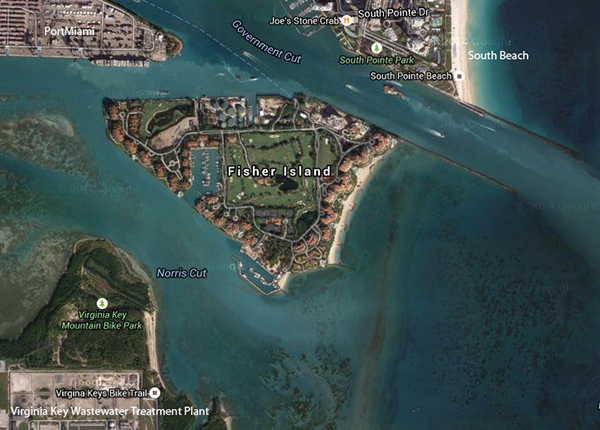
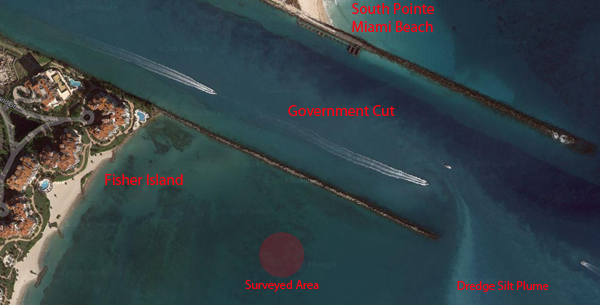
The Deep Dredge of Government Cut has caused significant coral stress and mortality on the corals and reefs in and around Miami… including wide areas that the Army Corps predicted would not be affected. In particular, the dredging at PortMiami has resulted in vast sediment plumes that arc around the south-side of Fisher Island and out through Norris Cut where federally protected elkhorn corals are suffering.
As mitigation against this coral die-off and stress, Coral Morphologic proposes the construction of an ‘urban coral research nursery’ along the edge of South Pointe Park where the public can be directly engaged with the marine ecosystem of Miami. This coral nursery will be built primarily to house and grow fragments from the variety of Acropora corals living around Fisher Island. The coral nursery will be a proactive mitigation response to a shameful coral transplantation effort on Fisher Island and the siltation-related mortality of coral around Miami.
In order to test the resilience of these Fisher Island Acropora corals, it is imperative that these colonies are grown and cloned into as many individual colonies as possible. Not only will this allow for exhaustive in-situ research projects, but it will also result in additional fragments useful for restoring reefs around Miami after the Deep Dredge is completed. Because the Fisher Island Acropora corals are so unique, the only way to properly test their resilience is to fragment them repeatedly over time to create enough cloned test subjects. Because the hybrid Acropora corals are not conferred federal protection, their clones are ideally suited for life in educational public aquarium reef displays around the globe where they will become fluorescent icons of adaptation and resilience for both Miami and coral-kind.
Coral Morphologic proposes that such a coral nursery should be deployed just inside Government Cut along South Pointe Park which provides ideal water conditions for growing all of the Miami’s ‘urban coral’ species; especially the Fisher Island Acropora corals. The South Pointe coral nursery will provide coral biologists with a low-cost, easily-accessible platform in which to pursue unique coral research projects that only Miami affords. Close access to land-based electrical and internet infrastructure will allow an array of tools that offshore nurseries can’t count on such as 24/7 live streaming underwater web cameras, flow meters, and water chemistry monitoring probes. A continuous stream of open-access data on the water quality moving into and out of Biscayne Bay with every tide will be necessary to provide the City with the most accurate information possible in which to predict future sea level rise and pollution. Furthermore, the addition of interactive signage will engage and educate citizens and tourists about the overlooked marine ecology of Miami Beach.
This coral nursery project will cost in the tens of thousands of dollars and require a long list of permits and permissions from agencies at the city, county, state, and federal level. While the levels of bureaucratic protection for corals are meant to be helpful, it also presents considerable roadblocks for those wishing to cultivate them for restoration and research. While an initial $10,000 Accelerator Grant from the Miami Foundation has kickstarted the planning process in earnest, we will be requiring more grant funding and donations to complete the project. We look forward to updating everyone on this project as we move forward to grow the rare and resilient ‘urban corals’ of Miami and Fisher Island!
Fisher Island Hybrid Fused Staghorn Coral (elkhorn morphotype) pre-dredge/ mid-dredge health survey.
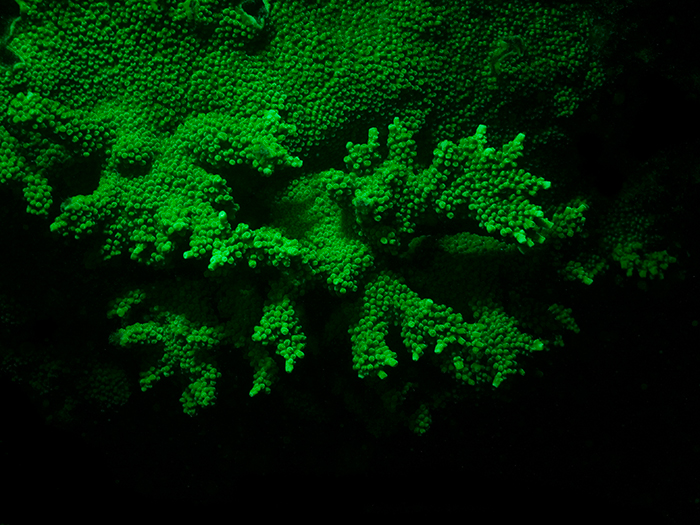
The most remarkable aspect of the health of the corals growing on Fisher Island, is the success story of two hybrid fused-staghorn corals (Acropora prolifera) that live along its shorelines. The story of the first hybrid coral is well documented through the TEDxMIA talk Colin conducted in 2011. This hybrid coral appears to be much more palmate in its growth morphology which typically means that its mother was a staghorn and its father an elkhorn. This coral has proven to be the most remarkably resilient of the Fisher Island Acropora corals. While its growth has been somewhat slow, it has never demonstrated any evidence of significant die-off, white pox, or bleaching. It also features significant amounts of fluorescent green proteins which may confer it with an adaptive advantage over its non-fluorescent parent species.
However, there is another equally unusual hybrid fused-staghorn coral living on Fisher Island that we’ve also been observing since 2009. And it demonstrates a much more compact branching staghorn morphology, indicating that its mother was likely an elkhorn coral and its father a staghorn.
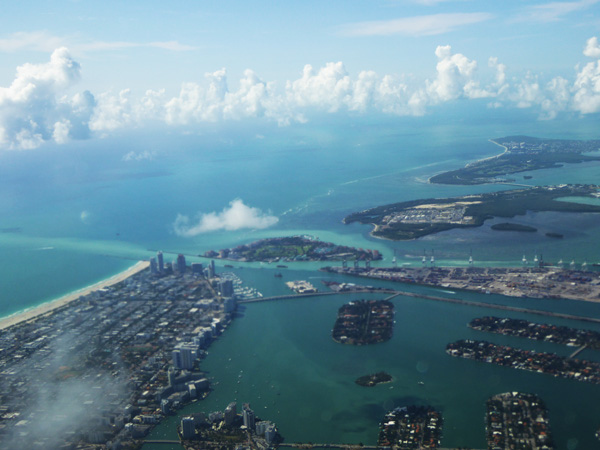
Aerial view of Biscayne Bay and Government Cut. Fisher Island is encircled in the Army Corps’ Deep Dredge silt 4/14/15.
Over the past eighteen months, the Army Corps of Engineers’ Deep Dredge of PortMiami has continuously released dirty water throughout Biscayne Bay and onto our surrounding reefs. The dredging will continue through at least August 2015. Over the course of the Dredge project we have observed levels of suspended silt far beyond what is environmentally acceptable or healthy in a coral reef environment. Silt that is directly causing coral mortality in areas far beyond where the Army Corps predicted.
One of Coral Morphologic’s biggest ongoing concerns during the Deep Dredge has been the well-being of a hybrid fused-staghorn coral (Acropora prolifera) colonizing the Fisher Island side of Government Cut. This coral is what kickstarted our interest in documenting the extent of coral colonization within Miami’s coastal waterways, and was the subject of Colin’s 2011 TEDxMIA talk ‘A Hybrid Future – The Corals of Miami‘. The concerns we expressed to the State of Florida about this coral is ultimately what led them to provide us with permits to rescue corals from the dredging far offshore… but not for the hybrid itself (or any other corals on Fisher Island).
We’re psyched to share a soundtrack of ours (‘Strand’) is part of Other Electricities‘ new “call and response” LP, where Emile Milgrim and T. Wheeler Castillo’s Floridian field recordings are included in original and remixed forms. Stream Archival Feedbackvia Spotify and pick up the album in digital and vinyl / deluxe editions @ https://other-electricities.bandcamp.com/album/archival-feedback
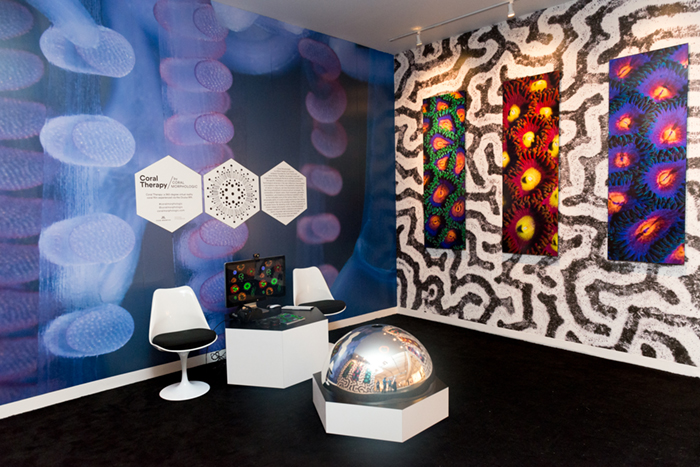
The ‘Coral Therapy’ Design Curio at Design Miami/ 2014.
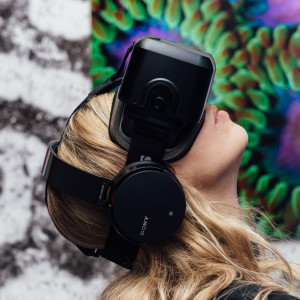
For Design Miami/ 2014, we were honored to be asked to create a conceptual room in which we debuted Coral Therapy, a 360-degree virtual reality film experienced via the Oculus Rift. When viewing Coral Therapy, the viewer is enveloped by fluorescent corals and sea anemones; much like being inside a virtual planetarium theater. Coral Therapy is designed to convey a virtual out-of-body experience in which the viewer is transported to a tranquil tropical reef in outer-space. An original ambient score enhances the cosmic coral perspective while accentuating the peaceful and relaxing experience.
As we last reported, a combination of hot weather and sunny days in summer 2014 has resulted in very a bad year for coral bleaching in South Florida. In this dispatch, we surveyed the natural reef just offshore Fisher Island here in Miami. To make matters worse, the water is exceptionally silty from the Army Corps’ dredging of Government Cut less than half a mile away. The water is 10-15 feet deep here, and nearly all of the coral heads were bleached. However, the most alarming condition we observed was the prevalence of black band disease infecting many of the brain corals. While healthy corals can usually recover from a bleaching episode, a coral suffering from both bleaching and black band disease will probably die. As evidenced from the video, the dredge silt has settled on the corals, and is likely a culprit in causing this black band disease outbreak. Currently, the dredge ships are operating just outside the mouth of Government Cut jetties, resulting in plumes of silt that smother corals on the natural reefs in every direction.
Fortunately, we have seen the water temperatures steadily decrease since the start of September, so we are hopeful that the bleached corals throughout South Florida will begin to recover soon. However, up here in Miami with the Deep Dredge ongoing, our corals may be too stressed out, diseased, or smothered to survive. We will be monitoring the situation closely, and will continue to update as necessary.
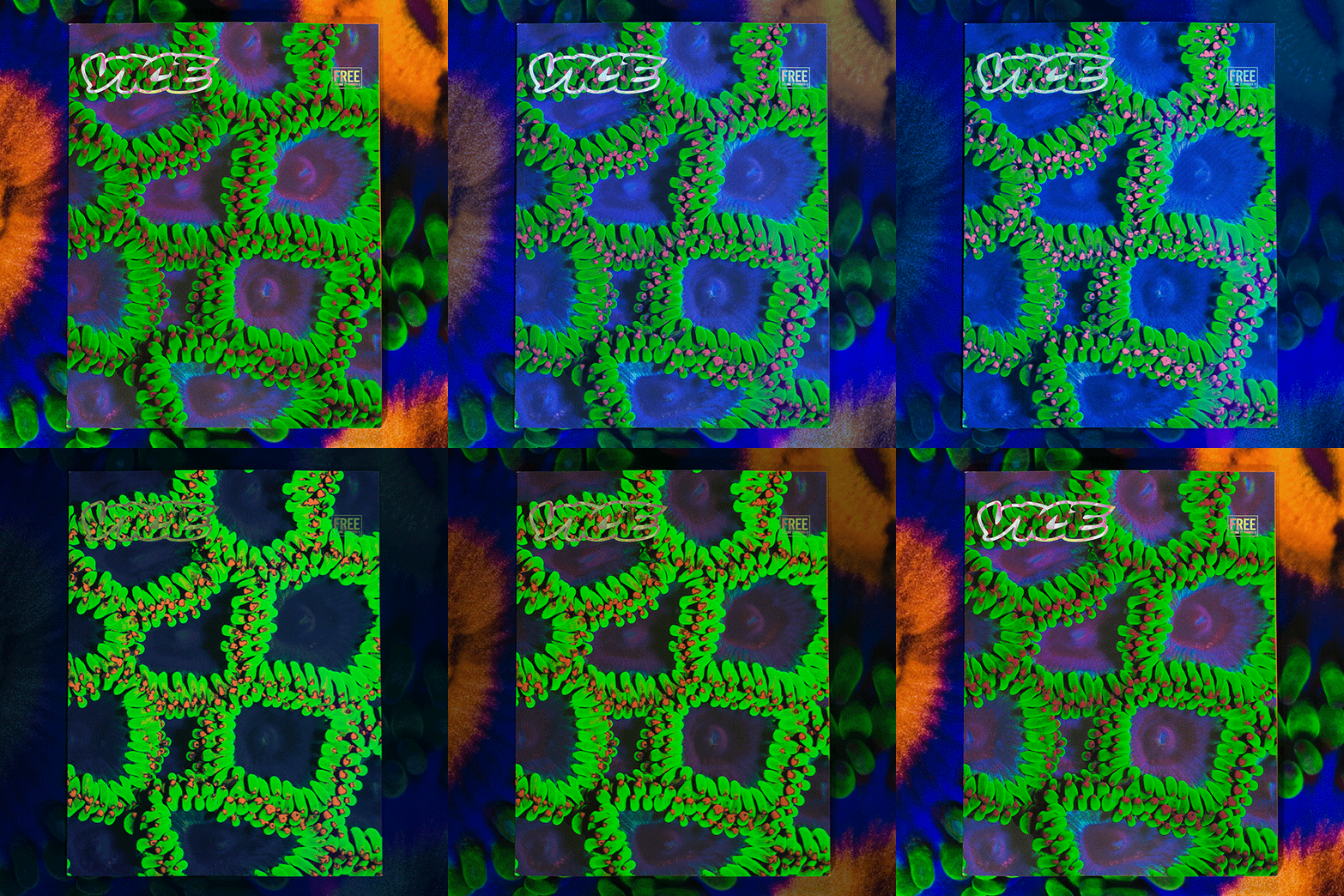
A morphing loop of ‘The Humongous Fungus Among Us Issue’ photographed under daylight, blacklight, and fluorescence filter.
Be sure to pick up a copy of the August, 2014 offering from VICE Magazine, ‘The Humongous Fungus Among Us Issue’, which features a special blacklight-reactive cover depicting Zoanthus polyps cloned and photographed in the Coral Morphologic lab. The issue’s contents are also available online, including the cover story, ‘Miami Is Drowning‘, by John McSwain.
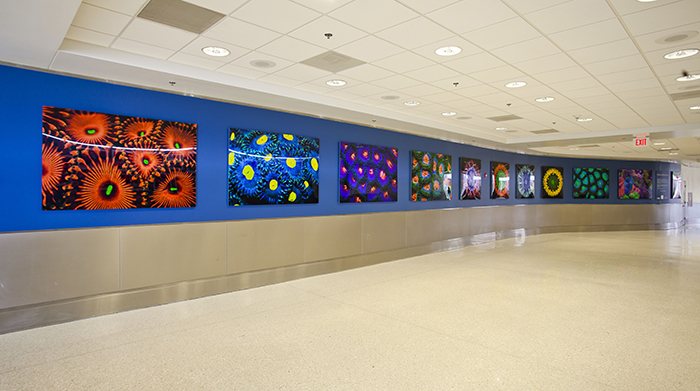
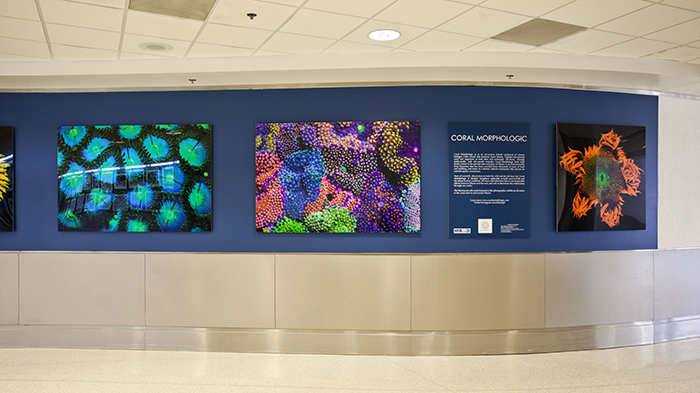
Flower Animal exhibition at Miami International Airport, 2014. Photos: Oriol Tarridas.
We are proud to share that Miami International Airport/ MIA Galleries has unveiled an 80-foot spread featuring selections from our local marine life photography collection, Flower Animal. The exhibition is comprised of eleven metallic-paper, diasec-mounted prints, and is located in the Concourse D.
Update 2018: As of 2018, Flower Animal now resides in Concourse E/ International Arrivals.
A hyper-fluorescent juvenile Montastrea cavernosa rescued from Government Cut.
After months of impatiently watching dredge ships working offshore Miami, Coral Morphologic and other researchers were finally granted a brief window of opportunity from May 26 until June 6th in which to rescue corals left behind from the legally-required relocation effort from the Army Corps of Engineers’ Deep Dredge of Government Cut. This was a much shorter length of time than we had been prepared for, and as such, we had to respond with considerable urgency in order to rescue as many corals as possible. Fortunately we had begun our detailed preparations in January 2014 by coordinating students and professors from the University of Miami to help in the effort. Collectively, the Miami Coral Rescue Mission removed over 2,000 stony corals that would have otherwise been destroyed in the process to make way for the larger ships that will pass through the soon-to-be-expanded Panama Canal.
The majority of the corals that Coral Morphologic removed from Government Cut have now been transplanted to an artificial reef about one mile south from where they originated, and where we will continue to monitor them to ensure their long-term survival. Some corals will be sent to the Smithsonian Institution for research. And the rest of the corals were brought back to our Lab, where we will document them via film and photography for a body of work titled ‘Coral City’, in which we will present them as fluorescent icons for a 21st century Miami.
While we could have rescued more corals with an extended deadline, the Miami Coral Rescue Mission is not over. It is now entering a longer-term monitoring phase in which we will continue to assess the health of surrounding coral reefs through July 2015, when the Deep Dredge project is finally slated for completion.
Coral Morphologic is proud to announce the digital release of the remixed and remastered Natural History Redux this Thursday, March 6, 2014. NHR compiles our original 23 ‘Natural History’ videos (that were previous only available online individually in 720p) into a digital 1080p collector’s edition.
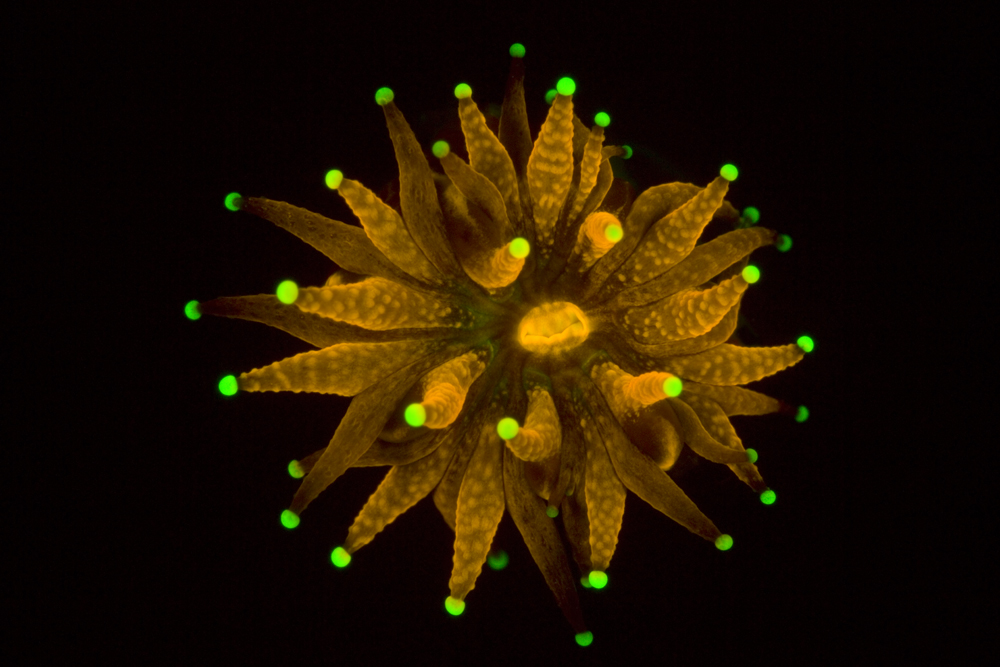
Seen above is a fluorescence photograph of an ultra rare hybrid staghorn coral (Acropora prolifera) living in Miami’s Government Cut waterway. Colin first introduced this coral to the world at TEDxMIA in 2011. Now the Army Corps of Engineers’ “Deep Dredge” project to expand Miami’s port capabilities will necessitate the evacuation of this and thousands of other corals before their habitat is dynamited. It is Coral Morphologic’s mission to rescue them. Find out more 7:30pm Tuesday January 21st 2014 at the University of Miami Cox Science Building Room 145.
We are psyched to share that our short film Fungia Food was included in the ‘Nature’ episode of Adult Swim‘s showOff The Air. Check out the episode above.
We are psyched to debut the Coral Morphologic + Dylan Romer-directed video for Dim Past‘s ‘Spectre In Wire’, an aquatic cut off the Black Dolphin EP. Utilizing Google Glass and GoPro devices, we take a trip down the Miami River, through Government Cut, and out to the sea, our destination. There we dive in and illuminate the Corals of Miami, keepers of a magical yet ephemeral realm. Dylan Romer’s reality-augmenting ‘Time Piles’ application treats the exploration, holding the experience together like a glue until we resurface.
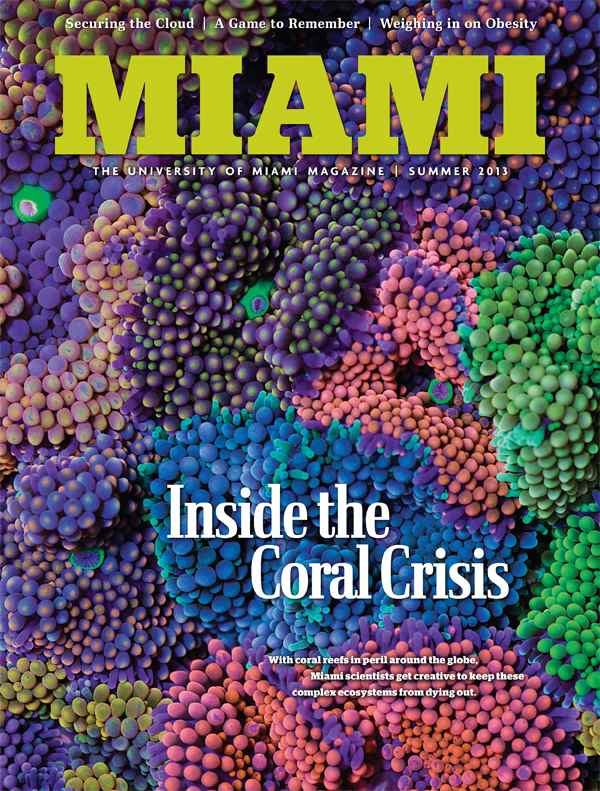
We are honored to be featured in the most recent issue of the UM Magazine and have one of our photos featuring a menagerie of our colorful Ricordea florida color morphs grace the cover. The article highlights the contributions of University of Miami alumni (’04) and Coral Morphologic co-founder Colin Foord to the body of science and public understanding of coral reef organisms through site-specific and multi-media artworks. The aquacultural legacy continues with our mentorship of University of Miami marine science students who get hands on experience growing corals within our Overtown laboratory.
We are psyched to announce the release of a series of skateboard decks in collaboration with MIA Skate Shop featuring the photography of three different fluorescent corals that call Miami their home. The collaboration is a logical extension of our view of Miami as the Coral City. A city whose cement buildings are metaphorical monuments to the fossilized remains of an ancient coral reef that once ran through it. Skaters will now be able to skate through a city of coral (recycled as concrete) on boards that reflect its bio-geologic past, present, and future. Miami, a city where vertebrate and invertebrate life-forms are forever bonded through calcium carbonate. Calcium carbonate skeletons that were once enveloped with fluorescent coral tissue now form the foundation for a neon metropolis that mirrors its coral reefs. A metropolis with an Atlantean destiny, where corals will one day recolonize the streets and buildings as their own.
The limited edition decks (3 color-ways, hand numbered editions of 50) will be available starting Saturday, May 25 at the release party, and at both MIA shops in Miami Beach and Sunny Isles, Florida.
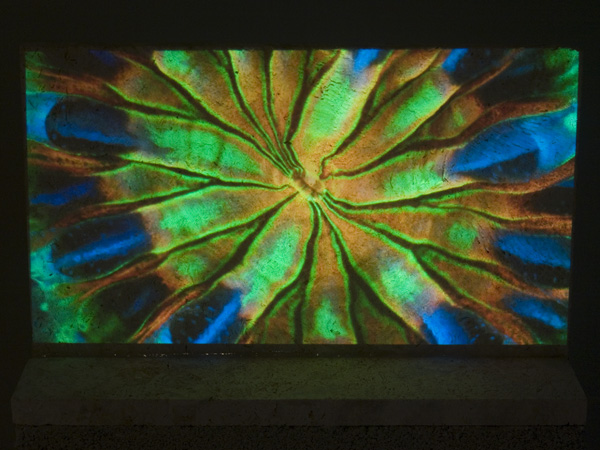
From April 13 – May 4 we will have Tombstone, our new installation, on exhibition at Swampspace in the Design District of Miami. The piece consists of a projection of Colpophyllia natans thrown onto a keystone screen of its own fossilized ancestors, set upon concrete blocks, they themselves comprised of calcium derived from ancient Floridian reefs.
During the week of Art Basel-Miami Beach 2011, we opened the doors of our aquaculture lab and welcomed guests to see our work and inspirations up close and personal. Jeff Jetton and Brendan Canty (of the band Fugazi) were two of our guests from Washington, DC, and we were psyched to give them a detailed look at our lab, our ethos, and how we managed to develop a DIY hybrid science-art concept into reality.
Check out the video from Colin’s TEDx talk, where he highlights Miami’s urban corals – specifically a rare hybrid “super” coral that may help in future rehabilitation of Florida’s fragile reefs.
We are thrilled to share that Colin will be counted as a speaker at the TEDxMIA 2011 annual conference Between The Lines, September 13th at the New World Center on Miami Beach. He will expound the adaptational prowess of an extremely rare “hybrid” Caribbean stony coral (Acropora prolifera) he discovered while exploring the waters of Biscayne Bay and Government Cut. Click here to read an interview with Colin on the meaning of this find and what it predicts for the future of Florida’s coral reefs.
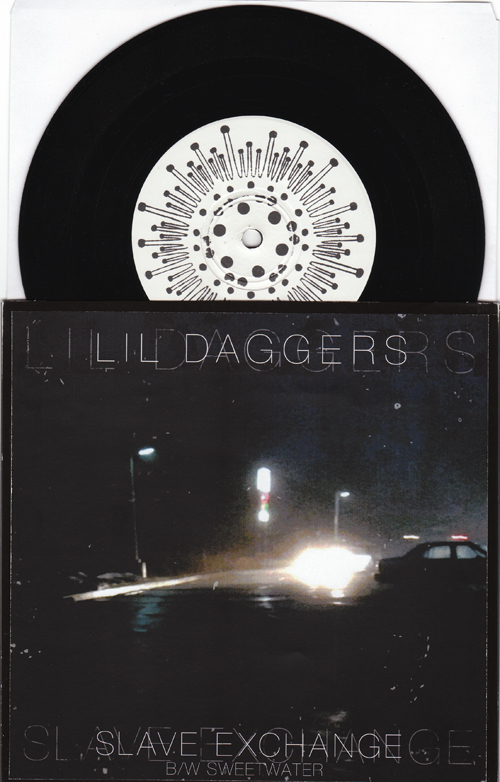
We are proud to announce the fifth release in our South Florida-centric 7″ vinyl series; ‘Slave Exchange’ b/w ‘Sweetwater’, from Miami’s Lil Daggers. The wax is a limited edition run of 100 copies in black vinyl, with a wheat-pasted photo on each individual sleeve affixed by the band. As usual, we have rubber stamped our corallimorph logo onto the b-side of the center-sticker and stamped/ numbered the a-side.
The release party will be held within a party: Saturday, January 16th @ the 2nd annual Sweatstock. Check out the set times for a bigger picture of the event – many amazing bands will perform, including Discosoma’s Lil Daggers, Beings, and Guy Harvey. The 7″ will be available at Sweat Records exclusively Saturday, which is also Record Store Day. After Saturday, you can pick up the record at Sweat as well as the Coral Morphologic store.
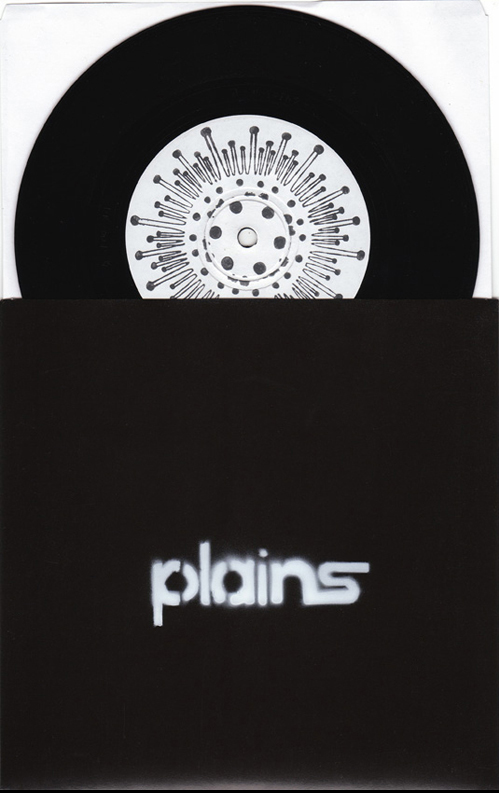
We are proud to present the debut 7″ vinyl release (‘Innovator’ b/w ‘Stuck In The Night’) from Miami’s Plains. The record is limited to 100 copies in black vinyl with individually-stenciled sleeve art by band leader/ songwriter Michael McGinnis. We have rubber stamped our corallimorph logo onto the b-side of the center-sticker and stamped/ numbered the a-side.
BAR is hosting the 7″ release party this Friday, September the 3rd with live sets from Plains and Animal Tropical. We will have the record for sale for $7 at the show.
For those who wish to purchase the Plains 7″ online, please see the Coral Morphologic store.
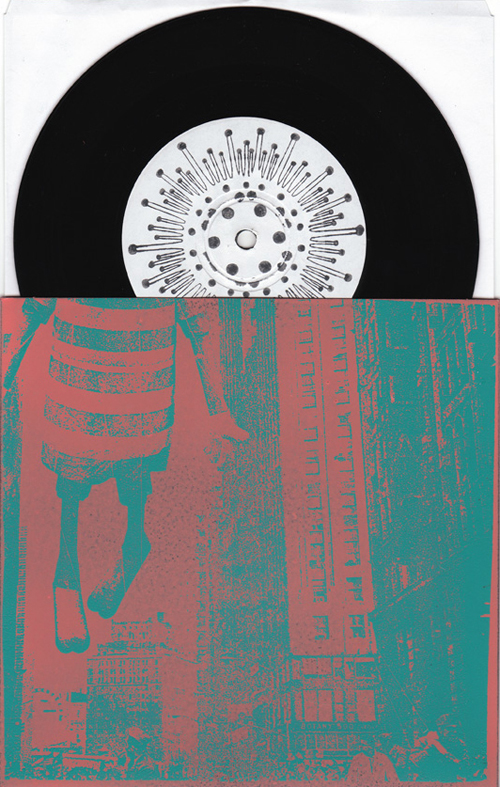
We are proud to present the debut 7″ vinyl release (‘Take Your Time (With Me)’ b/w ‘Never Seen Snow’) from West Palm Beach’s Guy Harvey. The record is limited to 100 copies in black vinyl with individually-screened sleeve art by the band. We have rubber stamped our corallimorph logo onto the b-side of the center-sticker and stamped/ numbered the a-side.
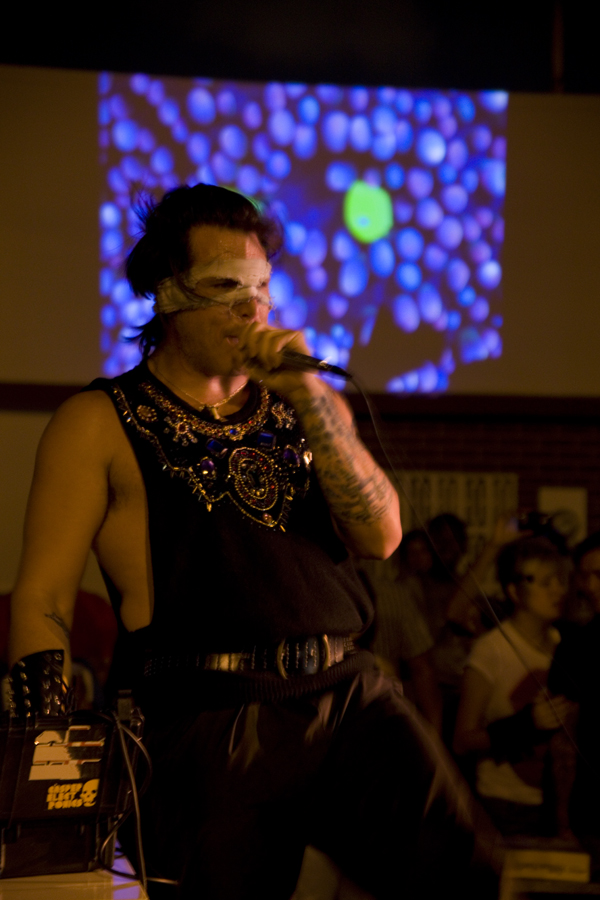
To celebrate The Vagabond is hosting the 7″ release party this Friday the 13th with sponsorship by Sweat Records and the live sounds of Guy Harvey and The Jameses. We will have the record for sale for $7 at the show; see you there!
For those who wish to purchase the Guy Harvey 7″ online, please see the Coral Morphologic store.
On Saturday April 17th, we projected two video loops during ‘Sweatstock’; a free, all-day, all-ages block party in Miami’s Little Haiti neighborhood celebrating Sweat Records 5-year anniversary. For No Age, Sweatstock’s headliner, we projected the neon green mouth of a Fungia sp. coral that actively ‘smiled’ over the energetic performance and enthusiastic audience, as seen in the video above.
Prior to No Age, we displayed an undulating, double-mouthed Ricordea florida polyp for Otto von Schirach‘s swamp-freak take on Miami Bass (below).
We are proud to have helped contribute to what we consider was the best music festival Miami has seen in recent memory. Congrats and thanks to Lolo and Sweat Records for an awesome 5 years of organizing and promoting our Miami music scene; the Magic City would be a lot less magical without your hard work and drive.
During the nights of Art Basel Miami Beach our 2009 film reel was displayed on the 80′ X 42′ LED screen on the facade of the American Airlines Arena in downtown Miami as part of the Media Mesh Project. The video compilation was curated by artist George Sanchez-Calderon and featured short films by the following artists: Lou Ann Colodny, Aiden Dillard, Alvaro Ilizarbe (Freegums), Justin Long, Ferran Martin, Coral Morphologic, Gavin Perry, Carlos Rigau, Bert Rodriguez, Damian Rojo, TM Sisters, and Jen Stark.
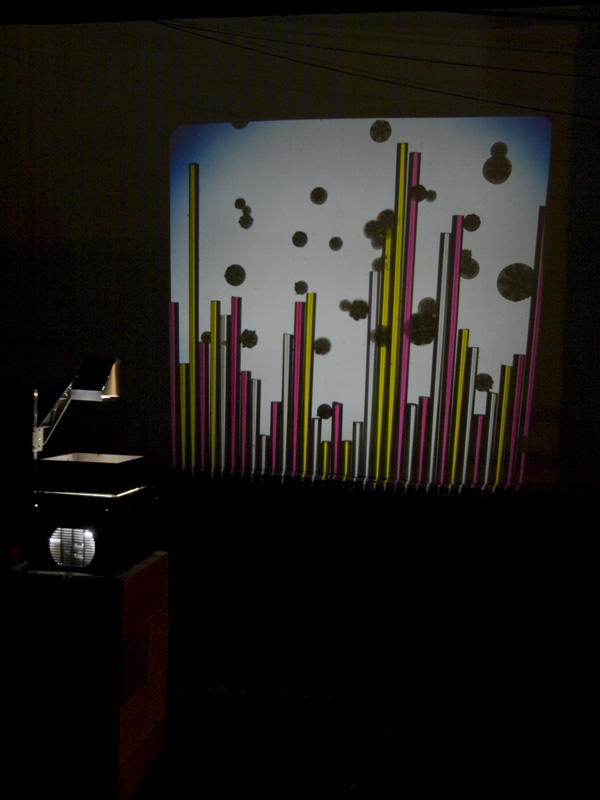
Still photo (above) of aquarium/ projection of our contribution to the Sweat Records X Iggy Pop t-shirt release party, August 22, 2009 at the Awarehouse in the Wynwood Art District. This installation consists of a 10″ X 10″ X 4″ acrylic aquarium atop an overhead projector projecting a 15′ X 15′ image onto the courtyard wall. The live-action component of the installation features a performance by thirty photosynthetic jellyfish (Cassiopea xamachana) collected in the mangrove estuary near the Virginia Key Wastewater Treatment Plant, here in Miami, FL.