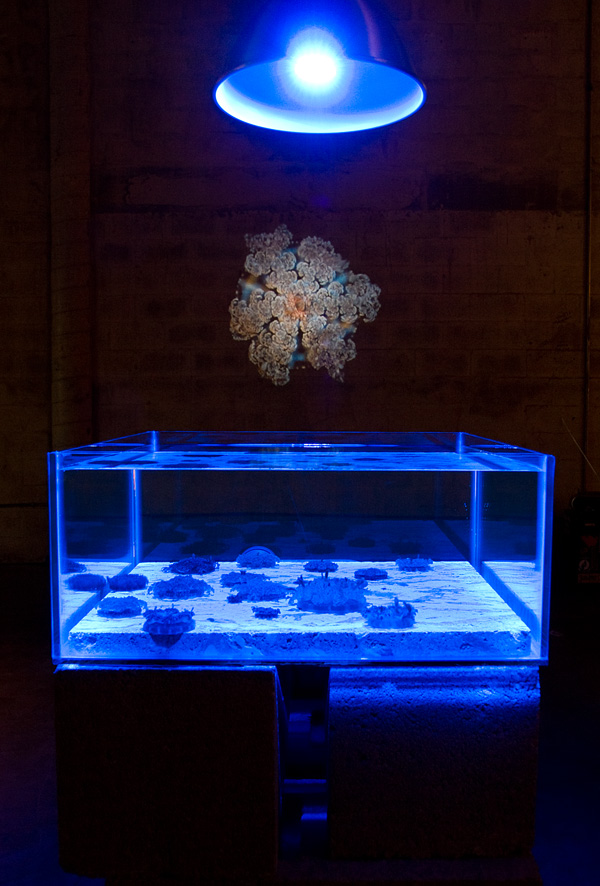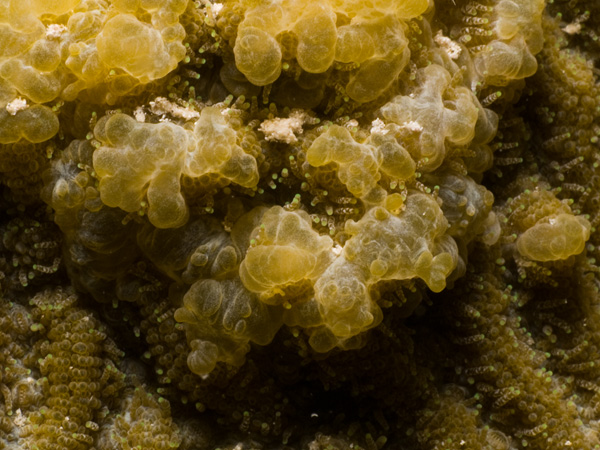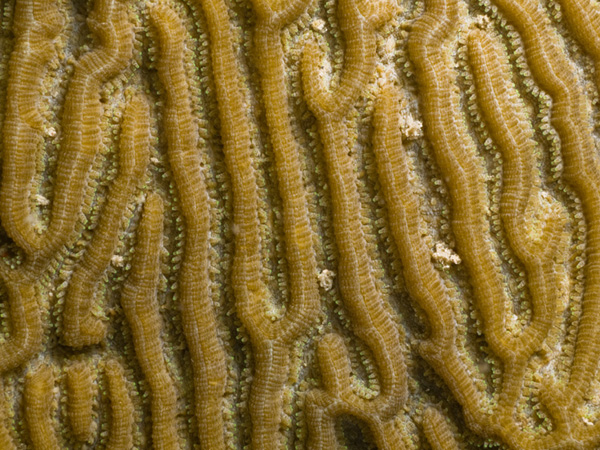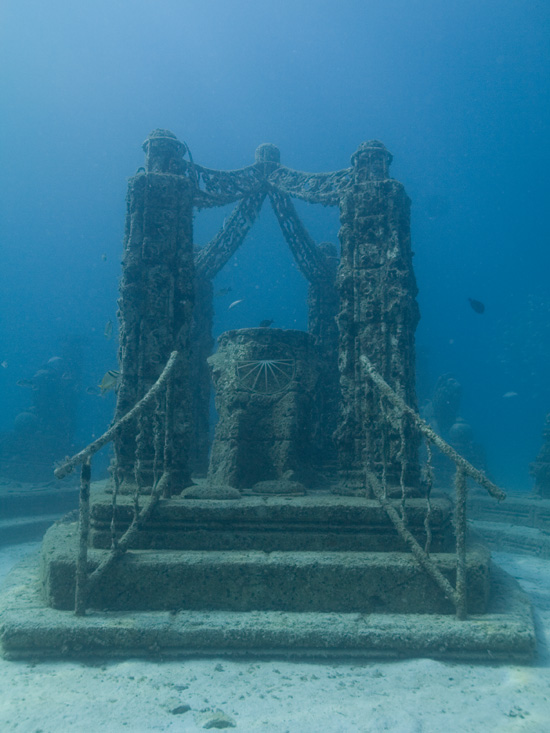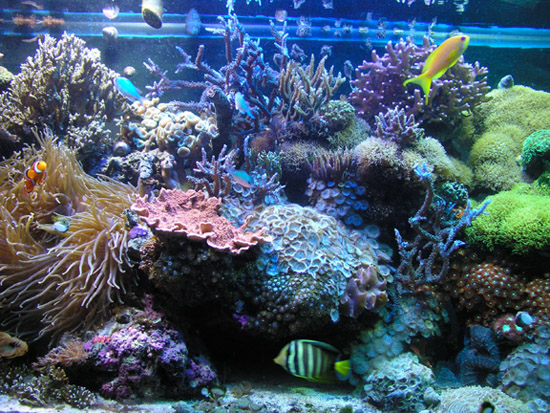
We were disheartened to receive a call from our good friend Lauren Reskin, owner of Sweat Records, this past Sunday with the news that her store had been broken into, thieved, and trashed. The worst karmic act committed was the wanton destruction of the Red Sea Max that we installed and maintained as a gift to her store and our friends that frequented it. We set up the aquarium at the very end of November 2007 for the opening of Sweat’s third incarnation here in Miami.
According to the police, the thieves cut through the security gates of the store’s back entrance early Sunday morning and proceeded to steal the store’s computer, electronic equipment, several pieces of art from the walls and… knock over the aquarium.
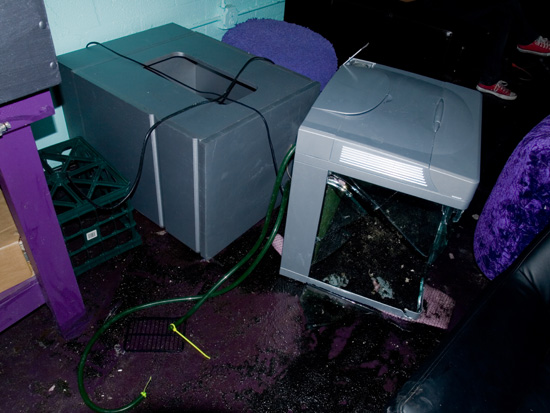
This what we arrived to find (minus the live rock and corals that we had already gathered up by this point in our effort to revive what we could.
Sweat Records was closed on Sunday, so it wasn’t until almost 9 pm Sunday night that Lauren happened to be driving by her store and noticed the break in. It is likely that the contents of the aquarium were dry for over 18 hours.
We arrived at Sweat Records in a daze, unable to believe that someone would go through the trouble of destroying an aquarium just for the thrill of instant destruction, until we saw it with our own eyes. We were expecting the worst; that nothing could possibly still be alive.
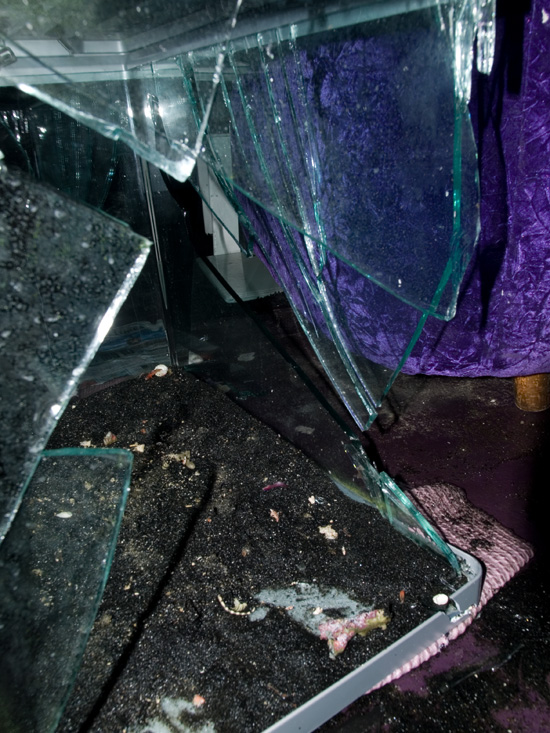
All of the fish were dead. We hypothesize that the impact and subsequent shock-wave of the aquarium shattering against the floor must have killed them immediately as there was several inches of standing-water still on the floor that could have otherwise provided them with refuge.
However, there was some good news. Both of the harlequin serpent stars and a porcelain crab showed minimal signs of life, despite being nearly dry. When plopped into a plastic bag with water, they revived within a few minutes. The snails and blue leg hermit crabs all survived. We were initially highly skeptical that the Discosoma sp. corallimorphs would survive 18+ hours out of water, but we gathered up all of the pieces of live rock and brought them back to our facility anyhow. We didn’t want to put them into our holding or grow-out systems, as we were afraid that if they died as we expected, they would only foul the water. Instead, we placed them in two 18 gallon mortar tubs with heavy aeration and a power head and hoped for the best.
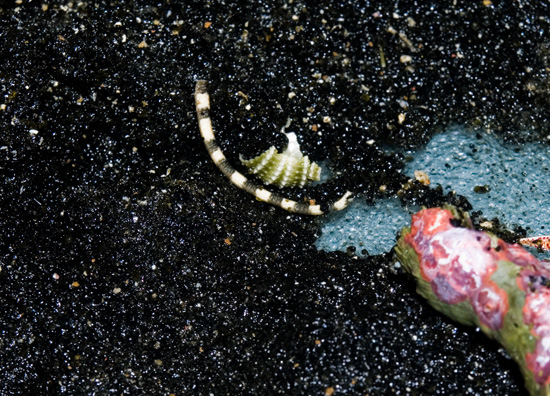
The severed arm of a harlequin serpent star is seen above. Fortunately, the serpent survived the ordeal and more than 18 hours out of water. It will regenerate this arm in short time. The fish weren’t so lucky.
To attest to the ruggedness of the Red Sea Max, the hood and even the light bulbs remained undamaged despite the brute force impact. Likewise, the RSM’s silver stand escaped even minor scratches despite landing face down. The two return pumps were the only other parts of the RSM beside the actual glass aquarium that had to be thrown out. Because the electrical cords never pulled out of the wall, they continued to run dry after the fall. This caused them to overheat and melt together! The Current 1/10hp chiller managed to unplug itself and therefore survived with nary a blemish.
We were relieved the following morning to find that most of the corallimorphs were recovering nicely. Now, almost a week later, they have nearly made a complete recovery. We did lose a few polyps, but I’d estimate at least 80% survivorship.
Unfortunately, we did lose about half of the pink coralline algae from the live rock. Coralline algae does the most amazing thing when it dies; it fluoresces a bubble gum pink color. While temporarily beautiful, it soon turns to a dead white bleached state within a day or so. If anyone knows why this phenomenon occurs, please inform us. To lose this much coralline algae cover from your live rock after nearly a year of cultivation is a real bummer.
You can see a fluorescence photograph of the live rock below:
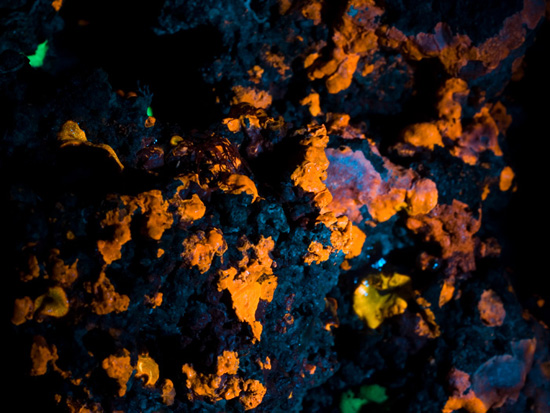
The dying pink crustose coralline algae fluoresces after death. The photograph was taken under blue wavelength (450 nm) light to maximize fluorescence. Several gold and green Discosoma sp. can also be seen fluorescing, despite 18 hours out of water.
While dismayed at losing this aquarium, and just as it was maturing into an exceptional little reef aquarium, we are not deterred. Sweat Records will be holding a series of benefit concerts in the next several weeks to help raise money for a better security system and a new aquarium. We hope to have another aquarium up and running by the time of Sweat’s first anniversary of being in their current location. We’ll keep you posted.
Here are a couple of articles written by local blogs about the break in:
Miami New Times
ARTLURKER