Posts Tagged ‘Perciformes’

A Few Fish from FLL

Wednesday, July 8th, 2009
July 7, 2009

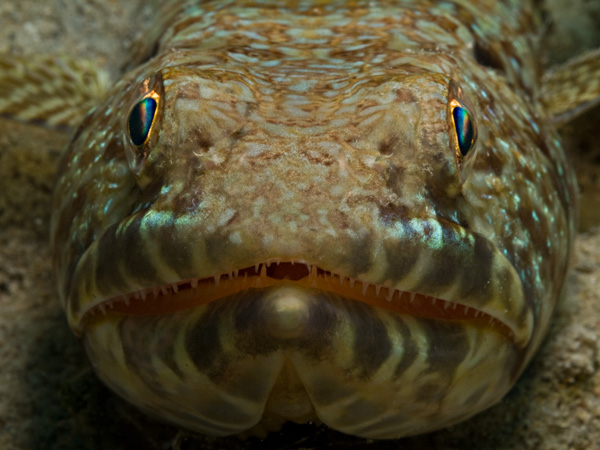
A toothsome ‘sand diver’ lizardfish Synodus intermedius waits patiently for a smaller fish to come a little bit closer…

On Tuesday morning, our newest team member Graham and I made a shore dive just underneath the flight path of the Fort Lauderdale International Airport (FLL).  I’d read that there was some decent shore diving in the area, but I have very little experience in this neck of the woods. 95% of all my dives in Florida have been in the Keys…  It was a nice change of pace, although if you go yourself, don’t expect to see the level of diversity and coral coverage you might find further south or offshore.

(more…)

Swimming in Circles…

Tuesday, November 11th, 2008

During the daytime, these medium-sized jacks (Caranx sp.) swim around in a tight ball, everyday, in roughly the same location, not 100 feet off the beach in Tulamben, Bali, Indonesia.  At night they disperse and hunt on their own, but during the day, round and round and round…

Banggai Cardinalfish: Population and Collection Statistics (Part 2)

Sunday, September 7th, 2008

A school of Banggai cardinals hovers above a protective anemone in the Lembeh Strait where the species has been introduced. March 2007.

In the previous segment, we took a look at the how the natural history and geographic isolation of the Banggai Cardinalfish (Pterapogon kauderni) makes it an unusual and unique shallow water ornamental marine fish species.  In this segment we will examine the population and collection statistics, the collectors, and the peripheral impacts…

(more…)

Banggai Cardinalfish: An Introduction (Part 1)

Monday, September 1st, 2008

A single Bangaii cardinal takes refuge above a Diadema sp. urchin at dusk in “Secret Bay”, Bali, Indonesia where they are an introduced species.

The Banggai cardinalfish (Pterapogon kauderni), while seemingly ubiquitous to anyone who has recently become involved with marine aquaria, is in fact a relative newcomer to the trade.   In 1994 ichythyologist super duo John Randall and Roger Steene “re-discovered” this Indonesian fish (originally described in 1933), and introduced it to the saltwater aquarium world at the MACNA VII conference. Immediately, the Banggai cardinal became a coveted prize for aquarists, and prices for a single fish easily exceeded $100.  However, over the coming decade, aquarists happily saw these prices decrease and the supply increase.  Unfortunately, it wasn’t well known at the time just how unique and vulnerable their population is in the wild. Currently, the Banggaii cardinalfish is listed as “threatened”  by the IUCN (International Union for Conservation of Nature). This listing does not confer any sort of special protective status to the fish or limit collection/trade.

In June 2007 an effort was made to list the Banggai cardinalfish as a CITES schedule II species, which would require an export permit (like stony corals and seahorses) and an annual limit.  The proposal was defeated, but it is unlikely that the issue will disappear from the table anytime soon.  In fact, it represents an area where we as marine aquarists are presented with an urgent issue that we can work to turn around if we make informed decisions.  The purpose of this article is to examine the natural history, population structure, collection pressures, and why it matters so much to us as marine aquarists to understand the situation.

(more…)

Juvenile High Hat

Friday, August 15th, 2008

I snapped this photo on the same dive that I shot the mating pair of gold-crowned nudibranchs not far offshore from Key Biscayne on Emerald Reef.  I am not 100 percent certain of the identity of this fish.  When they are this size (<3 inches), the juveniles of high hats (Pareques acuminatus), jackknife fish (Equetus lanceolatus), and spotted drums (Equetus punctatus) look nearly identical. As the latter species suggests, all three of these species are part of the drum family (so called because of some members’ ability to “vocalize” during courtship and mating). If I had to hazard a guess I’d say that this one is a high hat, based on the spot on its nose and band across the eyes. To really appreciate the beauty of this fish though, you have to observe it in action:  It takes full advantage to its long finnage as it undulates and swims cyclically. Because of it’s constant motion, it can be deceptively difficult to photograph. For such a defenseless fish, these movements must be confusing enough to thwart most predators. The juveniles stay mostly protected underneath ledges, caves, and near crevices. Unfortunately, the grace and beauty of the high hat declines over time as the long dorsal and caudal (tail) fins shrink in proportion to the body.  Jackknife fish and spotted drums by comparison keep their long fins into adulthood, although they are still most exaggerated as juveniles.

Mandarinfish (Part 2)… Mini Spearguns VS. The Status Quo

Saturday, May 10th, 2008

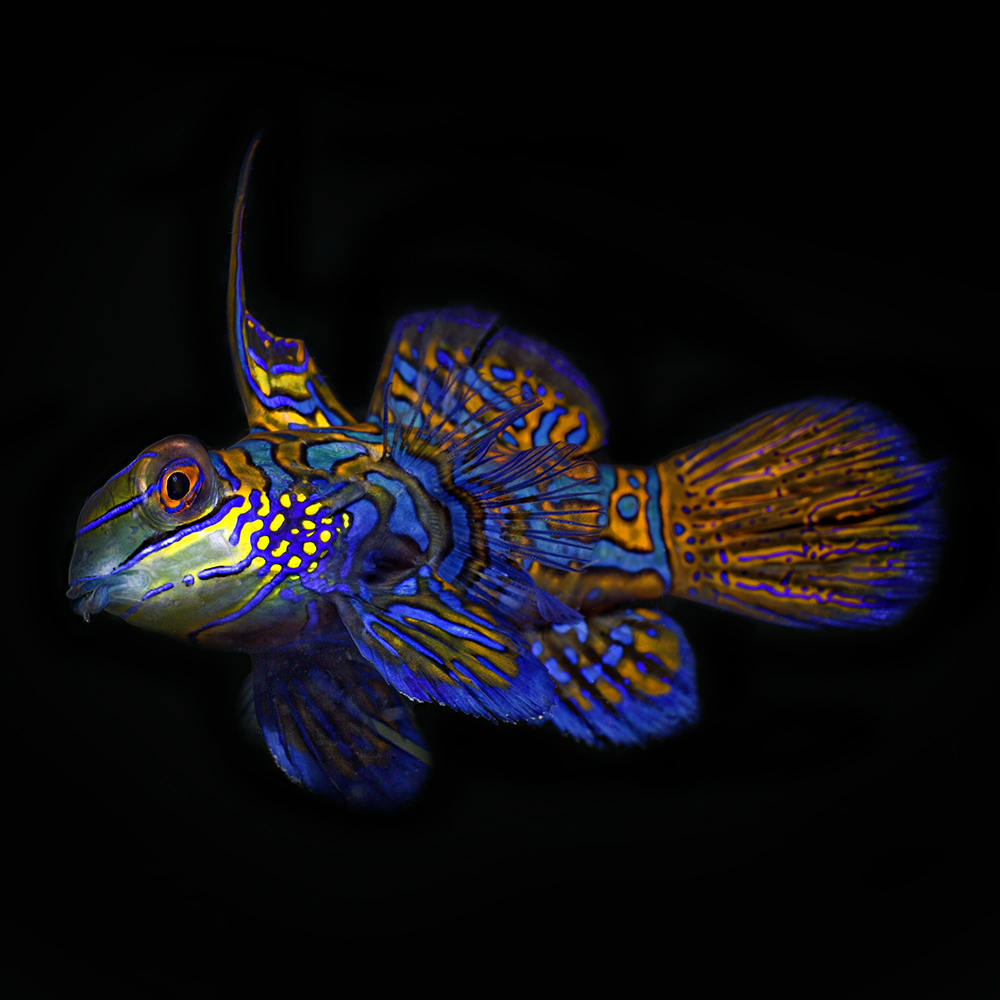
In the second installment of the mandarinfish saga, I describe a unique method of catching the blue mandarin dragonet (Synchiropus splendidus) that doesn’t involve using cyanide or nets. It involves using a teeny-tiny spear gun to (more-or-less) harmlessly capture this beautiful fish. It may sound barbaric, but I conclude that it is relatively harmless, and a less harmful alternative to sodium cyanide poisoning.

Click here to read more about this novel ornamental fishing technique…

Mandarinfish (Part 1)… A Natural History Primer

Saturday, May 3rd, 2008

From August 2006 until April 2007 I lived in Bali, Indonesia working as an intern with the Marine Aquarium Council (MAC Indo). My primary job was writing a simple coral mariculture manual (lagoon-based) useful for local fishermen as a “how to guide”. However, I was also able to follow along on MAC’s primary duties in the field, working with the local ornamental fisherman groups throughout Indonesia.

I have finally had some free time to sift through my journals and photographs, and look forward to posting some interesting articles on the marine aquarium trade in the future.

In this first installment, I describe the natural history of the blue mandarinfish (Synchiropus splendidus) a popular reef aquarium fish. In the second installment I will go on to describe a fishing technique that doesn’t involve using cyanide or nets. It involves using a teeny-tiny spear gun to (more-or-less) harmlessly capture this beautiful fish. It may sound barbaric, but I conclude that it is relatively harmless, and a superior alternative to sodium cyanide poisoning.

Click here to read more about the natural history and courtship behaviors of the blue mandarinfish…