Aberrant Tentacles of Ricordea florida
Saturday, April 18th, 2009
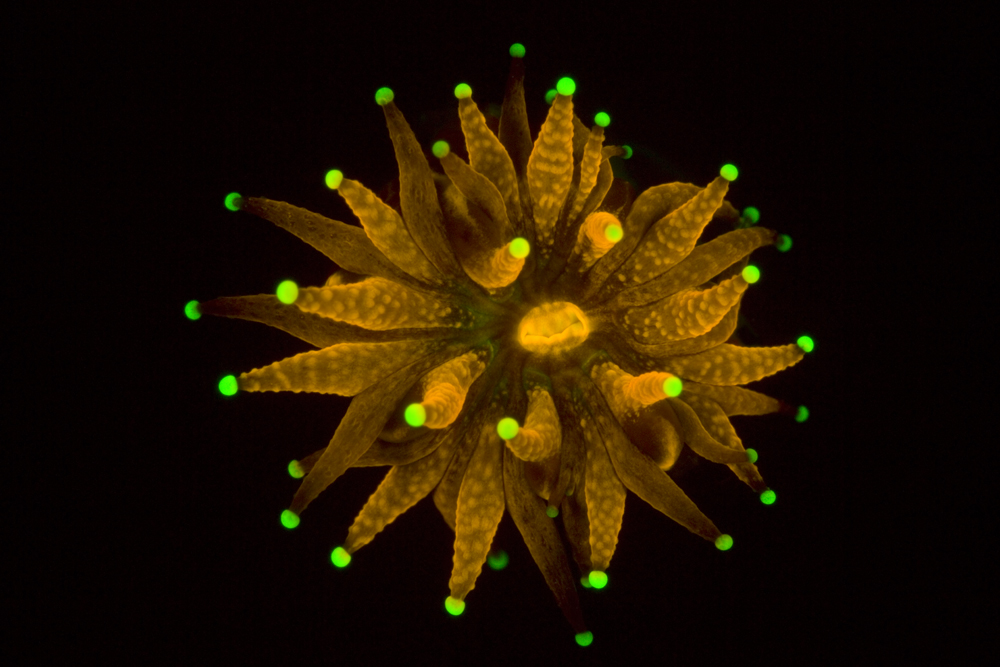
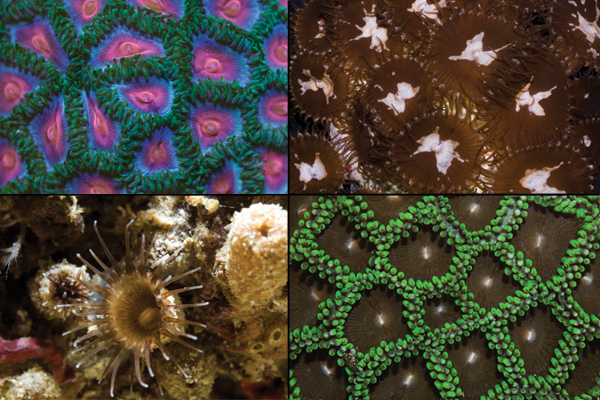
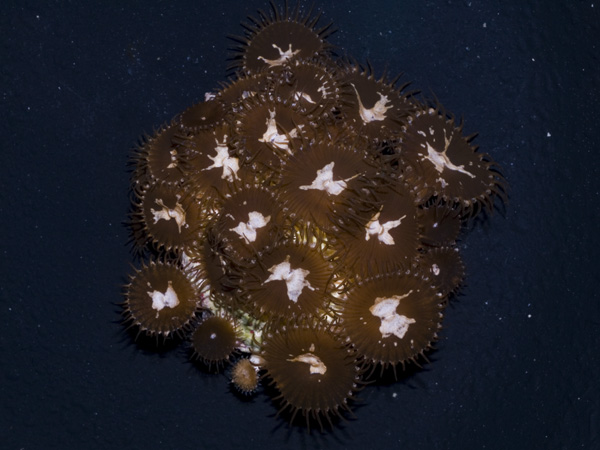
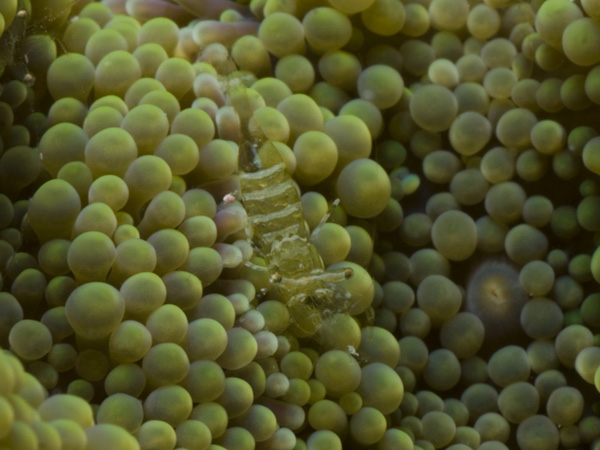
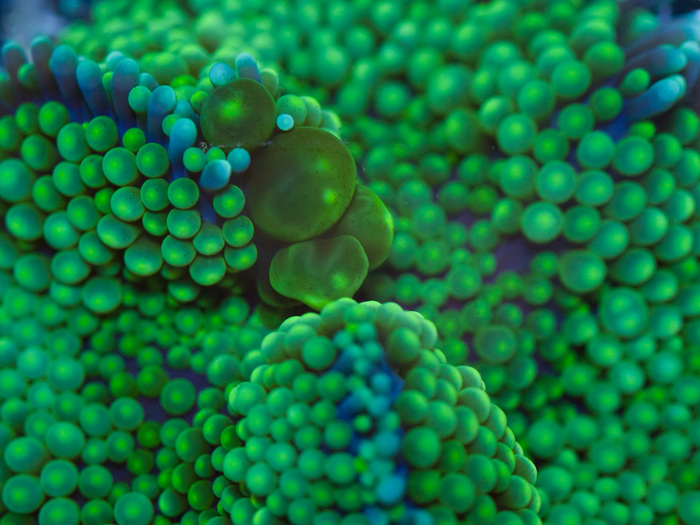
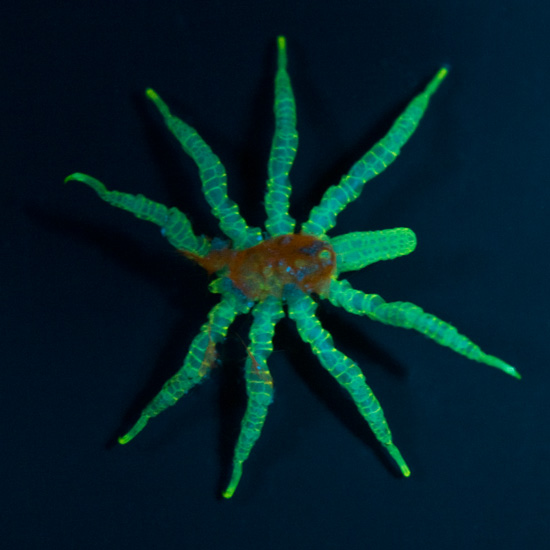
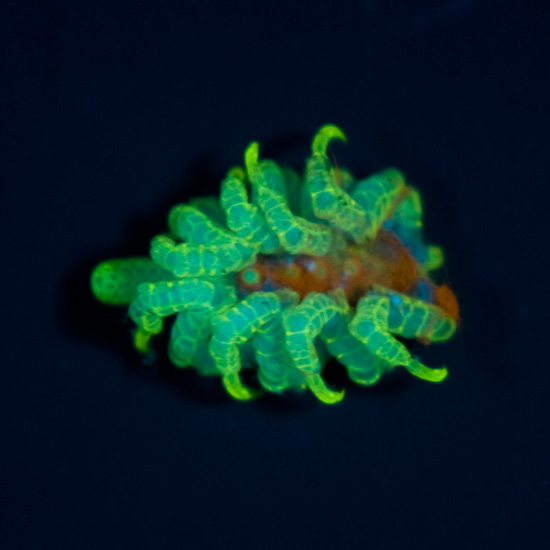
This neon green Ricordea florida polyp displays a few abnormally large tentacles. This is an unusual characteristic not yet observed before in the Morphologic Lab.

This neon green Ricordea florida polyp displays a few abnormally large tentacles. This is an unusual characteristic not yet observed before in the Morphologic Lab.

The cephalothorax of this unidentified pycnogonid is covered in wisps of cyanobacteria (perhaps as camouflage) which itself fluoresces orange-red. This specimen measures about 1 cm in diameter. Fluorescence photograph.
It is amazing the wide variety of sea creatures that demonstrate fluorescence. Animals that you would never suspect to “glow” do just that when illuminated with the proper wavelength light. For the past several years I have been using an underwater flashlight that I custom outfitted with 470nm blue LEDs in order to be able to scan for glowing creatures in the darkness. This pycnogonid sea spider (not an arachnid) is a prime example of an unexpected lifeform displaying an ability to fluoresce. The “spider web”-like pattern of fluorescence over this specimen is truly impressive.
Pycnogonids, commonly known as “sea spiders” are rarely seen in the wild (but not necessarily rare), and are an unusual class of arthropod. Most are very small (<1cm), and hence overlooked. However, in the Antarctic there are some monsters that can grow up to 90cm (Pycnogonaphobia?)! One of their most distinctive features is that they possess a proboscis (a drinking straw if you will) that allows them to suck out fluids from soft-bodied invertebrates such as corals, anemones, and corallimorphs. In the wild they rarely do lasting damage to their prey. However within the confines of an aquarium I could imagine that this might not be the case where their selection of hosts is limited. As such, they should be regarded as potential parasites of corals within the aquarium, and removed if detected. Despite this threat, they don’t seem to be widespread pests within the aquarium keeping world.

The same pycnogonid specimen in a defensive posture after being prodded “into position” for photography.

UFA #5 in its retracted state. This specimen only measures about 1cm in diameter.
UFA #5 is a small anemone that lives on the underside of rocks and rubble in intertidal habitats. I have found it in Tampa and in several locations up the East coast of Florida. The pictured anemone was actually living under the same rock as the previously featured UFA #4. They live colonially, suggesting frequent asexual reproduction. They are also quite small, ranging in size from 0.5-2cm across the body. Tentacles are generally retracted during the daytime and expand at night (see picture below). Its tentacles are usually uniformly grey, making it rather inconspicuously drab. The red ‘beads’ aligned symmetrically around the body column seem to be the most distinctive visual characteristic. The presence of these ‘beads’ leads me to believe that it might be part of the Bunodosoma genus, which share this characteristic. Some individuals display some radial white striping across the oral disc.

UFA #5 in its nocturnal expanded state for feeding.

UFA #4 in it’s normal, semi-contracted state. It is only about 1.5cm in diameter (Hooray for macro lenses, teleconverters, and diopters!).
For our fourth installment of the the “Unidentified Floridian Anemone” (UFA) series, we present this beautiful little anemone that I first discovered about 6 months ago. I found this specimen simply by spending time flipping over rocks and rubble in a shallow intercoastal inlet in less than 18″ of water, 10 feet from the shoreline. I suppose you’d call it luck…
This is a very small anemone species. The pictured specimen is one of the largest that I found (they live in small colonies of about 5-10 individuals), and it only measures about 1.5cm in diameter. The orange/red color fluoresces under actinic lighting, making the striped pattern that much more striking. It seems to spend most of its time in what I would consider a semi-contracted state (see photo above). During the day it often closes up (see photo below). Based on its preference for living on the underside of stones, I’m assuming that it is non-photosynthetic.

UFA #4 in a contracted state with a few mesenterial filaments visible (truth…I had to give it a gentle nudge in order for it to close up for the photo and it showed its dissatisfaction by extruding these filaments which otherwise aren’t visible).

The third unidentified anemone we are featuring seems superficially similar to Epicystis crucifer (Flower/Rock Anemone), but I am nearly certain that it is not. Notably, unlike E. crucifer, there are no magenta ‘beads’ on the underside of the oral disc. Also, the tentacles of Epicystis crucifer only grow around the perimeter of the oral disc, whereas this anemone develops some tentacles within the center of the oral disc. The underside is a light brown color and smooth. The tentacles have small ‘bulbs’ and pointy tips, similar to the ‘light bulb anemones’ found in the Gulf of Mexico, although the ‘bulbs’ are considerably smaller in scale. I have come across this species only about half a dozen times in all my diving in the Florida Keys. The mottled, earth-toned coloration makes them extremely well camouflaged on the seafloor, so it is likely that I have overlooked quite a few more. Preferred depth ranges from 10-20 feet on mixed hard bottom/gorgonian/macroalgae coverage. They live solitarily, anchored in small crevices and holes in the rock. Maximum size (that I’ve seen) is about 4 cm in diameter. Mottled colors vary from one individual to another, mostly brown and grey tones, and usually some blue around the mouth. Occasionally there will be a small amount of orange color splashed in as well. This anemone is almost certainly photosynthetic, as it will “reach” for the sun when in a shaded/low light situation. It eagerly feeds on frozen Mysis sp. shrimp. For size reference, this individual is living inside a Lithopoma tectum snail shell (about 2.5 cm in diameter).

This photograph was taken at night in an aquarium in order to capture the ‘mushroom anemone’s’ tentacles in full expansion. Within a few moments of being illuminated, this anemone will retract the tentacles back inside of itself. For size reference, the anemone is photographed inside an empty Lithopoma tectum (astrea) snail shell roughly 2cm in length.
The second unidentified anemone that we are featuring is a quite an unusual, shape-shifting creature. It lives on patch reefs and near-shore, hard-bottom gorgonian/macroalgae habitat from 5-25 feet of depth. During the day, the anemone only exposes the flat, warty surface of its oral disc, such that it lies flat against the bottom. It wedges its body into very small holes on the seafloor such that its body is completely protected within rock. At first glance while passing by one of these anemones, it is very easy to confuse it with local corallimorph Discosoma carlgreni, as their oral discs both have very similar texture, size, and shape. For this reason we have tentatively dubbed it a ‘mushroom anemone’. We are unsure whether this similarity is a form of mimicry, or simply coincidence. However, if this anemone is disturbed, it very quickly retracts itself back into its hole with a reaction time that greatly exceeds that of any corallimorph (corallimorphs lack fast-contracting bodily muscles). It is almost always found solitarily, whereas D. carlgreni is usually found in small colonies of clones.
I had only ever observed this anemone during the daytime while diving, but after collecting one for further examination, we were able to observe it at night in an aquarium. At night it shows its true anemone side by unfurling a ring of tentacles from inside its mouth. When lighted, the anemone will retract the tentacles. It appears that it must not feed during the day when its tentacles are withdrawn. However, the flat oral disc likely serves as a ‘solar panel’ on which to collect sunlight for the zooxanthellae that are presumably within the tissues. At night when the power of sunlight is moot, the anemone alternates to predator-mode and uses its tentacles to capture prey. Not a bad way to collect needed energy supplies over all 24 hours in a day…
This ‘mushroom anemone’ is a relatively small anemone, reaching only about 4cm in diameter across the oral disc. It is found in a variety of color morphs. “Silt grey” (blends into the seafloor perfectly) is the most common coloration, but I have also observed them in solid red, green, and purple morphs. They are not particularly uncommon in the Florida Keys, but they are very easily overlooked. The pictured specimen is mottled with fluorescent green on grey.

Pictured above is an unidentified ‘mushroom anemone’ in its daytime appearance. In the wild, you would not be able to see the body or base of this anemone, as it would be protected within a hole in a rock. A few of the tentacles are still visible within the anemone’s mouth, but typicaly they are not at all visible. The flat, warty surface of the oral disc is very similar in appearance to that of Discosoma carlgreni, a local corallimorph species. This small specimen measures about 20mm in diameter across the oral disc.
Below is the first in a series of sea anemone species that I have collected in Florida that defy my attempts to identify them.

Orange color morph of the unidentified “sunburst anemone” found locally along rocky Floridian seashores. It measures about 2cm across the oral disc.
Pictured above is an anemone that is found on both the east and west coasts of Florida. I haven’t yet found it in the Florida Keys, but it is likely to be found there as well. This anemone is pictured in Humann and DeLoach’s ” Caribbean Reef Creature ID” guide book on page 101, and listed as an unidentified species they dub as a “Sunburst Anemone”. However, in reference to its range, the authors write that it was “photographed in Los Frailes Islets, Venezuela where the species occurs occasionally; range has yet to be established”. It would seem logical then, that if it is reported in the extreme southern Caribbean and (now) on the Floridian coasts, that it can also be found elsewhere throughout the rest of the Caribbean basin. It is amazing that such a widely distributed, and relatively common anemone has yet to be formally described by science. This is likely due to the scarcity of anemone taxonomists active today.
At least from what I’ve observed in Florida, the “sunburst anemone” is found in shallow, rocky sub- to inter-tidal habitats. They are easily overlooked because it seems that they prefer shady crevices and the undersides of rocks. They live in colonies of dozens of individuals. They range in size from about 1″-2″ (2.5-5cm) in diameter. They show a diversity of color morphs ranging from rust orange to purple-red. White radial striping (the ‘sunburst’) is often present to varying degrees, but sometimes absent. Despite how vibrant they appear under flash photography, they unfortunately do not show any fluorescence.
Their natural habitat is prone to wide fluctuations in temperature, salinity, water quality, and even exposure to air at low tide. Thus they appear to be very hardy aquarium inhabitants. A small (pico/nano sized) species-specific aquarium would be perfect for these little anemones. Like other anemones, they are prone to moving from one location to another on their own accord. Threfore, they run the risk of getting sucked into pump intakes and harmful interactions with other corals or anemones. Ensure that the aquarium is “anemone safe” to prevent them from harm. I am not 100% certain whether they are photosynthetic or not, but I am erring towards ‘not’ due to their cryptic nature in the wild. Regular feedings of chopped fish, shrimp, etc. are most likely all that they need to thrive and reproduce.

Pictured above is an orange-brown morph of the ‘sunburst anemone’ with yellow-ish tentacles. It measures about 2cm across the oral disc.