

Boon! (cont.)
Finally, a break in the weather, and a superb one at that. Commuting from Miami to the Florida Keys is a bit of a unwelcomed task; not so much the drive, but more the time of the drive.
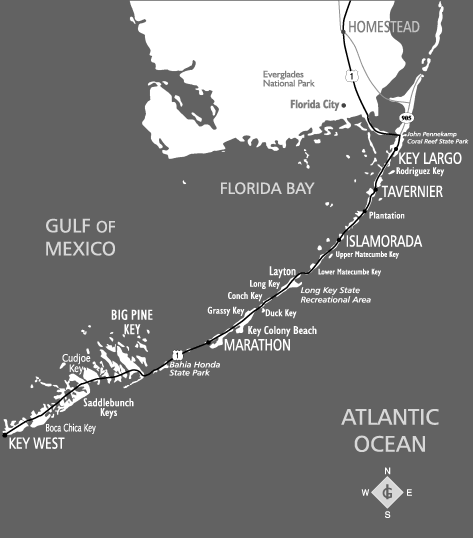
Wake up at 4:30am to get on the boat after 8. Even at that early hour there is a steady stream of traffic heading north into Miami from the ever burgeoning suburbs. Fortunately, heading south is smooth sailing. The sun rises just as I’m headed out of Key Largo. A sliver of light shines briefly before slipping again behind clouds. The clouds are low, and it isn’t long again before day finally breaks. Hitting the crests of the bridges between the Keys is always great at sunrise and sunset, and well worth the trouble of getting up so early. I have a bit of a love/hate relationship with the drive to the Keys. On the downside you have never ending construction, slow driving tourists on an un-passable two lane road, an aging infrastructure surrounded by new “luxury” condo developments, and cops. Lots of cops. State cops, local cops, county sheriffs, border patrol, fish and wildlife, undercover and unmarked. Monroe County (the Florida Keys) must have more law enforcement per mile of road than any other place in the US. After all, there is pretty much only US 1 to patrol, and with a steady stream of overly-confident tourists driving mustang convertibles, they never run out of work. Here is a bit of advice to anyone planning a road trip to the Florida Keys. Don’t exceed 5mph over the speed limit. Don’t push your luck, the cops here will pull you over; they want your “tourist tax”. For their benefit , the cops do a pretty good job keeping in check the drivers who are blatantly disregarding laws and putting other people in danger. Far too many traffic accidents and fatalities occur on this stretch of road every year.On the other hand, you can’t argue with what’s perhaps one of the most unique and picturesque stretches of highway in the lower 48. You can’t really argue against bridges, blue water, horizons and sunsets. A drive through the Florida Keys is just one of those things you should aim to do at least once in your lifetime. The 7 mile Bridge (famously demolished in a ball of flames by Arnold Schwarzenegger in True Lies…), is the crown jewel of the trip.We left the docks just after 9 a.m. We have 30 miles (25 nautical miles) to cover before arriving at our collection location. There is a bit of wind, and the sun, still low in the sky, is obscured by clouds. Foolishly, I forget any sort of wind breaker, or warm clothing. My optimism for 80 degree F weather is overshadowed by the reality of Winter. Cold is all relative, and complaining about winter weather is moot. It is January, in the low 70s, and I am finally on the water. This is only the second time in 3 months I’ve been able to get offshore. First I was landlocked developing this here new business, and then South Florida has been subjected to one weather system after another. Getting new livestock is my sole priority at this point. Oh, and also getting the website live.
After a little over an hour of travel by boat, we arrive at the collection site. The water is pretty calm, but there are some rolling waves. Despite my inclination for the water, I still get sea sick. And to someone that gets sea sick, gentle rolling waves can be a doozy. Fortunately for me there is meclizine, aka Dramamine 2 aka Bonine. However, even today after taking this anti-sea sickness medication, I feel a little woozy. Maybe I’ve been off of the water too long. The water is 72 degrees F, which may not seem so cold, but it doesn’t take too long for your body to be stripped of it’s energy without adequate thermal protection. Today I use a “new”, used wetsuit. Thanks to the power of Craigslist I am now the proud owner of a neon green and black 2-piece wetsuit. At 7mm thick, it’s not the most lithe piece of clothing one could wear, and getting into, and out of, the suit is a mission, made none the easier by having to concentrate on keeping my balance on the rocking boat while taking deep breaths and trying to focus on the horizon to minimize those familiar pangs of nauseousness.
We are truly lucky today. Visibility is actually pretty good. We can even see the bottom. I’m talking about a totally braggable 25 feet of visibility. To any recreational diver, 25 feet of viz is anything but braggable; but for a Florida collector in January; 25 feet is more than we could ask for. From the boat we can even make out boundaries of new patch reefs in the distance; new places to explore on another day. The sun emerges just as we begin the first dive. Sunshine makes all the difference.
For this first dive we are primarily concerned with collecting orange Ricordea florida. If you are reading this, you are probably aware of the beauty and the demand amongst aquarists for this species. We are diving on a patch reef in about 20 feet of water. The bottom is dominated primarily by large boulder-like coral heads; typically Montastrea spp., Diploria spp., and Siderastrea spp. Typical of Caribbean reefs, gorgonians fill the soft-coral niche. The regularity of turbid waters are a boon to these efficient filter feeders. Conspicuously absent from this grouping of corals are Acropora spp. Populations of these species plummeted due to disease in the 80’s and 90’s and have been very slow to recover in the Florida Keys. It always thrills me to see small, healthy colonies growing on our dive sites, but unfortunately I don’t encounter any today.
It only takes the time for me to reach the bottom for me to realize that this is a special spot. There are a wide variety of zoanthids growing amongst the coral colonies, often in silty depressions. Green, blue, yellow-Green, purple and all varieties in between are well represented here. Also well represented are the beautiful, and oft-overlooked (in my opinion ) bubble (aka warty) corallimorphs, Discosoma sanctithomae. But the real goal is the ricordea, so that’s what I spend my time searching for.
A 7mm wetsuit harbors a lot of small air bubbles within the neoprene, which is how neoprene possesses it’s insulating powers. However, all these tiny air bubbles impart a considerable amount of buoyancy to the diver, and therefore one has to overcompensate with extra weight to stay submersed. All that extra weight gets tacked onto my weight belt, which essentially loads up my lower back. Initially it isn’t much to deal with, but by the end of the day my back is going to feel the cumulative effects. Another problem with such a thick wetsuit is that it makes my legs overly buoyant, causing them to rise up. Therefore it is a constant battle to try and stay in equilibrium while underwater. All this means more exertion, greater use of air, less bottom-time, and a quicker onset of fatigue. On my way home I purchase ankle weights at a dive shop to reduce this problem on future dive days.
By the time I surface after the first dive, the weather has truly blossomed, and the wind has all but died. The water is like glass, although the rolling waves keep my eyes focused on the horizon as much as possible (this despite the meclizine…?). A peanut butter and honey sandwich, baby carrots, a Mac apple, and goldfish crackers provide sustanence. Kindergartener’s food; good stuff.
We decide to do an exploratory dive for our second dive. This could be hit or miss. It turns out to be a bit of both. We found no ricordea whatsoever, but we do find an abundance of the above mentioned Discosoma sanctithomae. It is likely that the reason for the lack of ricordea is that this site is just a bit too shallow. I have rarely found brightly colored ricordea in water less than 20 feet, and this site was in about 15-18 feet.
The 30 mile boat ride back to the dock was about as smooth and pleasant as you could ask for. I couldn’t possibly imagine a better way to spend a January day. Sun, water, all that good stuff. Hopefully the weather will hold out, and we’ll be back at it again this coming week.