coral morphologic header


Archive for April, 2010

‘Sally Lightfoot’

Monday, April 26th, 2010

‘Sally Lightfoot’
Percnon gibbsi crab amongst Anemonia bermudensis anemone garden
Music, Video, and Aquarium
2010 Coral Morphologic

The sally lightfoot crab (Percnon gibbsi) is an agile maneuverer on the rocky shores of the Caribbean. These crabs are particularly well-suited to life on craggy limestone rock in shallow water. The rockwork is the result of sea urchins eroding the limestone as they rasp off the algae growing on the surface. The cumulative erosion by sea urchins over many years creates a jagged network of fissures and channels through the solid rock. The sally lightfoot crab’s pancake-flat body allows it to scuttle beneath the protective spines of a nearby urchin at a moment’s notice. Anemonia bermudensis sea anemones like the ones seen in the film can also be common on the rocks in this surf-washed zone. The sally lightfoot’s nimble legs allow it zig-zag harmlessly between the tentacles of these stinging animals. Between the crab’s eyes you’ll notice a pair of fast-flitting antennae that detect the ‘smell’ of food in the water. The turbulence of the environment requires accurate detection and nimble response.
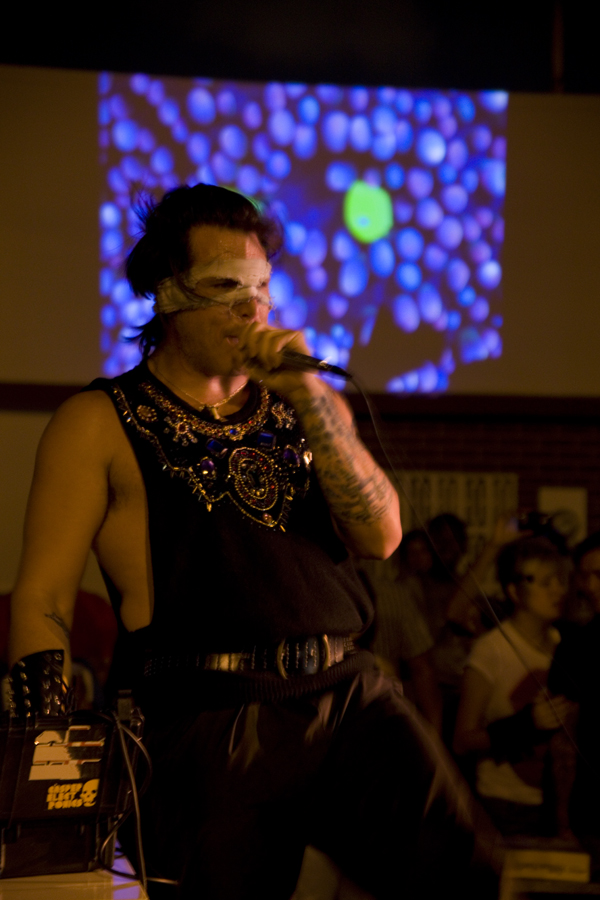
No Age & Otto von Schirach ‘Live Posters’ @ Sweatstock

Monday, April 19th, 2010

On Saturday April 17th, we projected two video loops during ‘Sweatstock’; a free, all-day, all-ages block party in Miami’s Little Haiti neighborhood celebrating Sweat Records 5-year anniversary. For No Age, Sweatstock’s headliner, we projected the neon green mouth of a Fungia sp. coral that actively ‘smiled’ over the energetic performance and enthusiastic audience, as seen in the video above.

Prior to No Age, we displayed an undulating, double-mouthed Ricordea florida polyp for Otto von Schirach‘s swamp-freak take on Miami Bass (below).

We are proud to have helped contribute to what we consider was the best music festival Miami has seen in recent memory. Congrats and thanks to Lolo and Sweat Records for an awesome 5 years of organizing and promoting our Miami music scene; the Magic City would be a lot less magical without your hard work and drive.

‘The Florist’

Monday, April 12th, 2010

‘The Florist’
Leptopsia setirostris (Decorator Crab) scavenging amongst a Zoanthus polyp garden
Music, Video, and Aquarium
2010 Coral Morphologic

Once again we return to observe a cryptic red decorator crab (Leptopsia setirostris); this time living upon, and decorated with, zoanthid polyps (Zoanthus sociatus), close cousins to both sea anemones and corals. Zoanthus in Latin literally means ‘animal flower’. The species name sociatus refers to the fact they these flower animals live socially in dense groupings of identical polyps.

Decorator crabs demonstrate a remarkably prescient instinct to be able process the information required to successfully camouflage themselves to match their preferred habitat. Unlike the typically fast-scuttling crabs of the mainstream, decorator crabs move at a deliberately slow pace to reduce being noticed.

This particular decorator crab species boasts a brilliant red exoskeleton that it has disguised with the zoanthids. The crab has carefully nipped individual zoanthid polyps from a larger colony and placed them upon its carapace (back) where they attach down on their own and continue growing. My experience suggests that it takes at least two days for a polyp to begin attaching down to new substrate. I have yet to observe the crab going through the whole process of zoanthid ‘decoration’, but clearly it is a very patient animal.

The crab uses its small claws to pick at and remove pieces of detritus between the polyps. The animal nature of the zoanthids becomes especially apparent when the movements of the crab cause the polyps to close up in reaction. If you look carefully at the bottom right of the screen you’ll notice the periodic movements of a barnacle that these zoanthids are growing upon. Zoanthids are commonly called ‘sea mat’ due to their rubbery, encrusting morphology. They live together in interconnected colonies of cloned polyps, slowly expanding their colonies outward; growing over shells, in-between coral heads, and across shallow tide pools.

‘Complex Nano’

Monday, April 5th, 2010

‘Complex Nano’
Music by Space Voodoo Crystal
Video and Aquarium
2010 Coral Morphologic

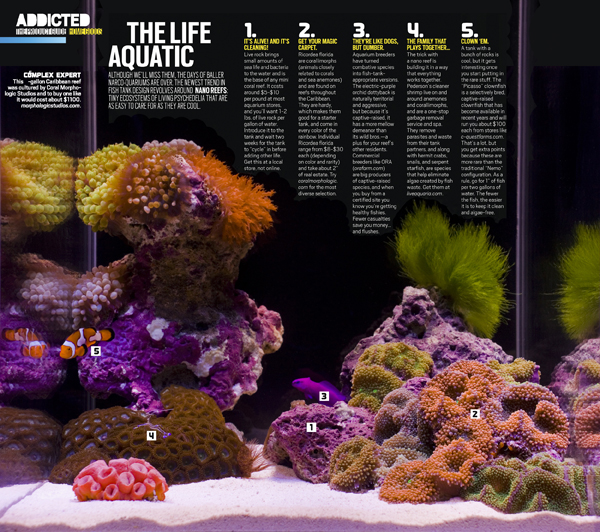
Above is a short video featuring a glow-in-the-dark perspective of the 5-gallon ‘Complex Nano’ reef aquarium. A daylight photo of this aquarium is featured in the April/May – 8th Anniversary Issue of Marc Ecko’s Complex Magazine (see below). By comparing the two differently illuminated versions of this nano reef, the true fluorescence of the corallimorphs and zoanthids immediately becomes apparent. The fluorescent pigments of the corallimorphs and zoanthids are preferentially activated under the 470 nm blue wavelength LED lighting used in the video. Notice that the normally bright orange coloration of the clownfish (Amphiprion ocellaris) appears nearly black in the film.

Both of the fish in the aquarium are captive-raised by the Harbor Branch Oceanographic Institute’s ornamental aquaculture subsidiary ORA. ORA has been a leader in this field, and we stand fully committed to the further development of  aquacultured ornamental marine fish species. You’ll notice that the normally three-striped clownfish has an unusual cross-pattern on one side. This is the result of selective breeding on ORA’s part.  In recent years, clownfish hatcheries have developed all black, white, orange, and ‘Picasso’, variations of the standard ‘Nemo’ through patient breeding and selection.

The other fish in the aquarium is an orchid dottyback (Pseudochromis fridmani). Wild versions of this fish tend to be more fiesty and territorial, whereas hatchery-raised fish tend to be more gregarious and better suited for life in a community reef aquarium.

Note the commensal (and nearly translucent) Pederson’s cleaner shrimp (Periclimenes pedersoni) on the fluorescent orange (Ricordea florida) corallimorphs in the video.

Click here for a complete species and hardware list

Special thanks to Patrick Albertson (article author) and Space Voodoo Crystal (soundtrack)