coral morphologic header


Archive for August, 2009

‘Magic City’ @ Sweat Records x Iggy Pop Party

Saturday, August 29th, 2009

Magic City

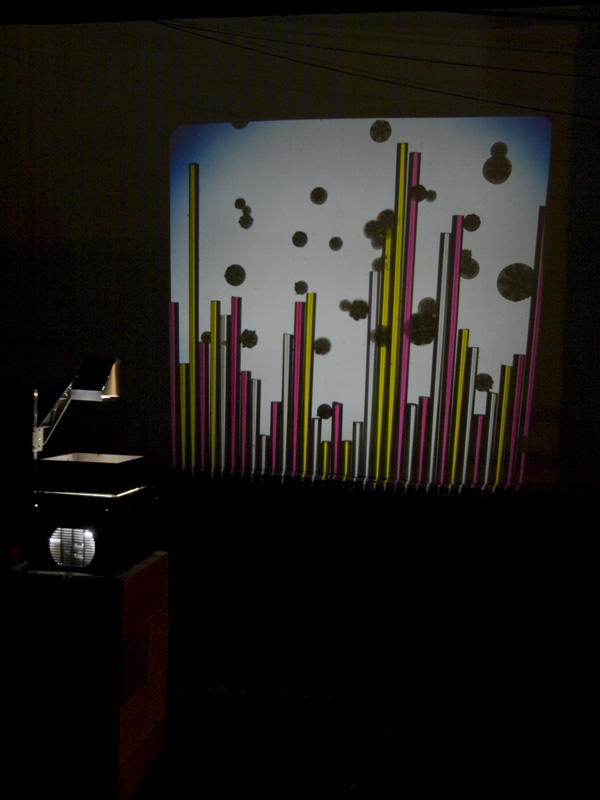
Still photo (above) of aquarium/ projection of our contribution to the Sweat Records X Iggy Pop t-shirt release party, August 22, 2009 at the Awarehouse in the Wynwood Art District. This installation consists of a 10″ X 10″ X 4″ acrylic aquarium atop an overhead projector projecting a 15′ X 15′ image onto the courtyard wall. The live-action component of the installation features a performance by thirty photosynthetic jellyfish (Cassiopea xamachana) collected in the mangrove estuary near the Virginia Key Wastewater Treatment Plant, here in Miami, FL.

Freshwater Oddity (Part 2)

Wednesday, August 26th, 2009

Pectinatella magnifica...a Freshwater Bryozoan

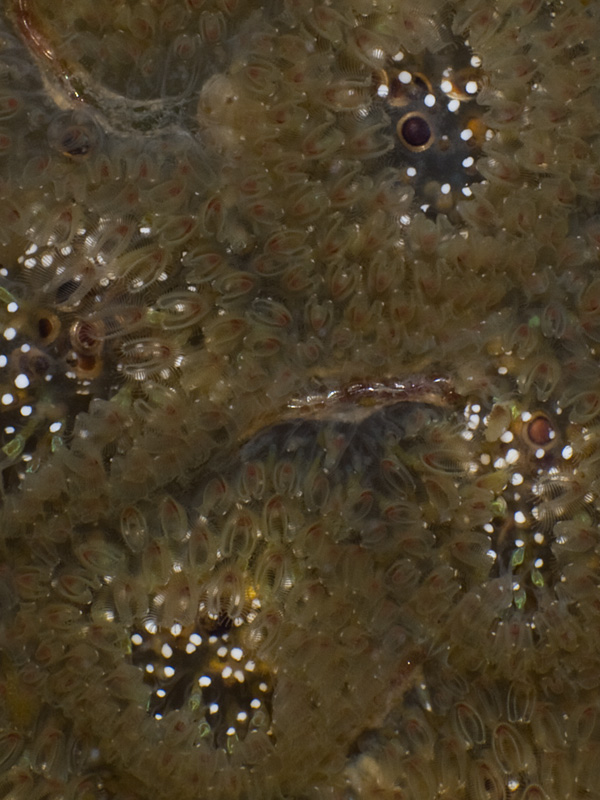
A close up of a colony of Pectinatella magnifica zooids; a freshwater bryozoan.

Pectinatella magnifica is another example of a coral reef cousin that I found living in a freshwater lake in Maine, alongside the previously featured Spongilla sp. sponge. From a distance, the colonies that these animals create appear as large jelly-like masses that might be confused with frog’s eggs (see photo below). They are typically found encrusting submerged tree branches, plants, and rocks. Most bryozoans are found in saltwater, but a few species such as P. magnifica are found in freshwater habitats. It would be forgivable to call the individual animals ‘polyps’, as they are superficially coral-like. However, unlike cnidarian (coral-like animals) polyps, bryozoan zooids have a complete digestive system with a separate mouth and anus, whereas cnidarian polyps have a single mouth/ anus opening.

If you look closely at the macro photo you will notice a couple of worms that are living in casings between the valleys that separate sub-colonial groupings of the zooids. The worms were wriggling constantly, most likely in an effort to create a water flow through their tubes that would draw in food items. It would be interesting to know whether these worms are specific only to Pectinatella magnifica, or whether they are simply opportunistic.
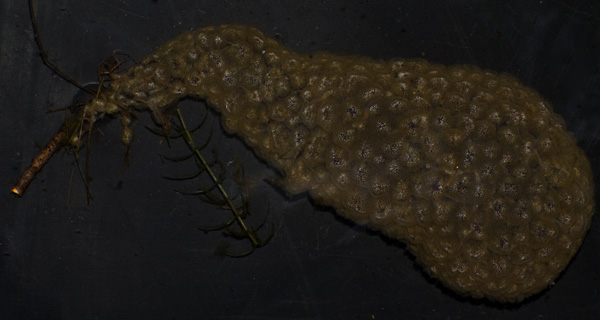
Pectinatella magnifica encrusting a submerged pine twig

The full-sized colony of Pectinatella magnifica looks and feels a lot like a mass of frog’s eggs. It has encrusted over a submerged pine twig.

Freshwater Oddity (Part 1)

Monday, August 17th, 2009

spongilla sp. freshwater sponge

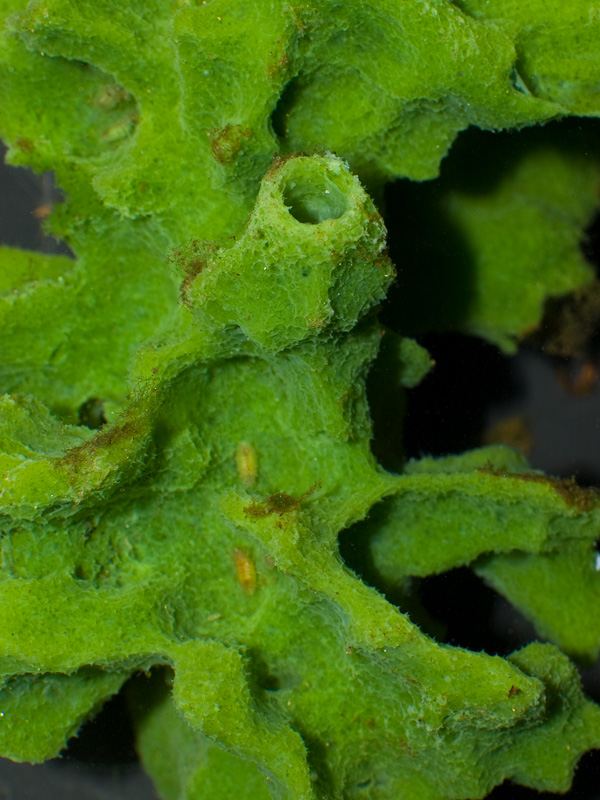
This freshwater sponge (Spongilla sp.) was found encrusting a submerged tree branch near the shoreline of a small lake in Maine. Note the small oval arthropods living on the surface of the sponge near the middle of the photo.

I recently returned from a short vacation to New Hampshire/ Maine to see family and stomp the formative grounds (and waters) of my youth. While paddling around the small lake that I spent my summers, I found an abundance of this freshwater sponge (Spongilla sp.) growing submerged near the shoreline. Growing on rocks it has a flat, encrusting morphology. On submerged branches it forms lumpy encrustations. And on shallow muddy bottoms it sends up skinny tendrils. The tissue is colored bright green due to a symbiotic association with algae. While you might find yourself thinking “freshwater sponge? really?”,  these sponges can be found across most of North America from Alaska south to Florida in relatively still freshwater lakes and ponds. As a testament to their adaptability, this sponge can ‘degenerate’ into a dormant state, forming tiny cysts called gemmules. These gemmules act as ‘seeds’ when favorable conditions return. The sponges reproduce sexually in the summertime and release free swimming larvae. Next time you find yourself at a lake, take a closer look at what you might otherwise think is just some lumpy ‘algae’.